But their Chinese was no better and no worse than mine. I had also used the Integrated Chinese textbook. I, too, knew Wang Peng. We were on the same itinerary so that we could fill in the same gaping lack, and the only thing that would resolve this was the passage of time—ten weeks in Taipei, immersed in our mother tongue—until we returned with perfect tones spilling out of our mouths, and we were no longer so bad at being Chinese.
page 3
Table of Contents
Why Taipei Story?
Regular readers of my blog will know that I have a bit of a fondness for the works of R. F. Kuang. You could say I am a fan, a fanboy even. I read Babel in 2024 and fell in love with her writing, That book was on my list of 2024’s books of the year. In 2025, I read Katabasis and fell deeper in love. That book was on my list of 2025’s books of the year.
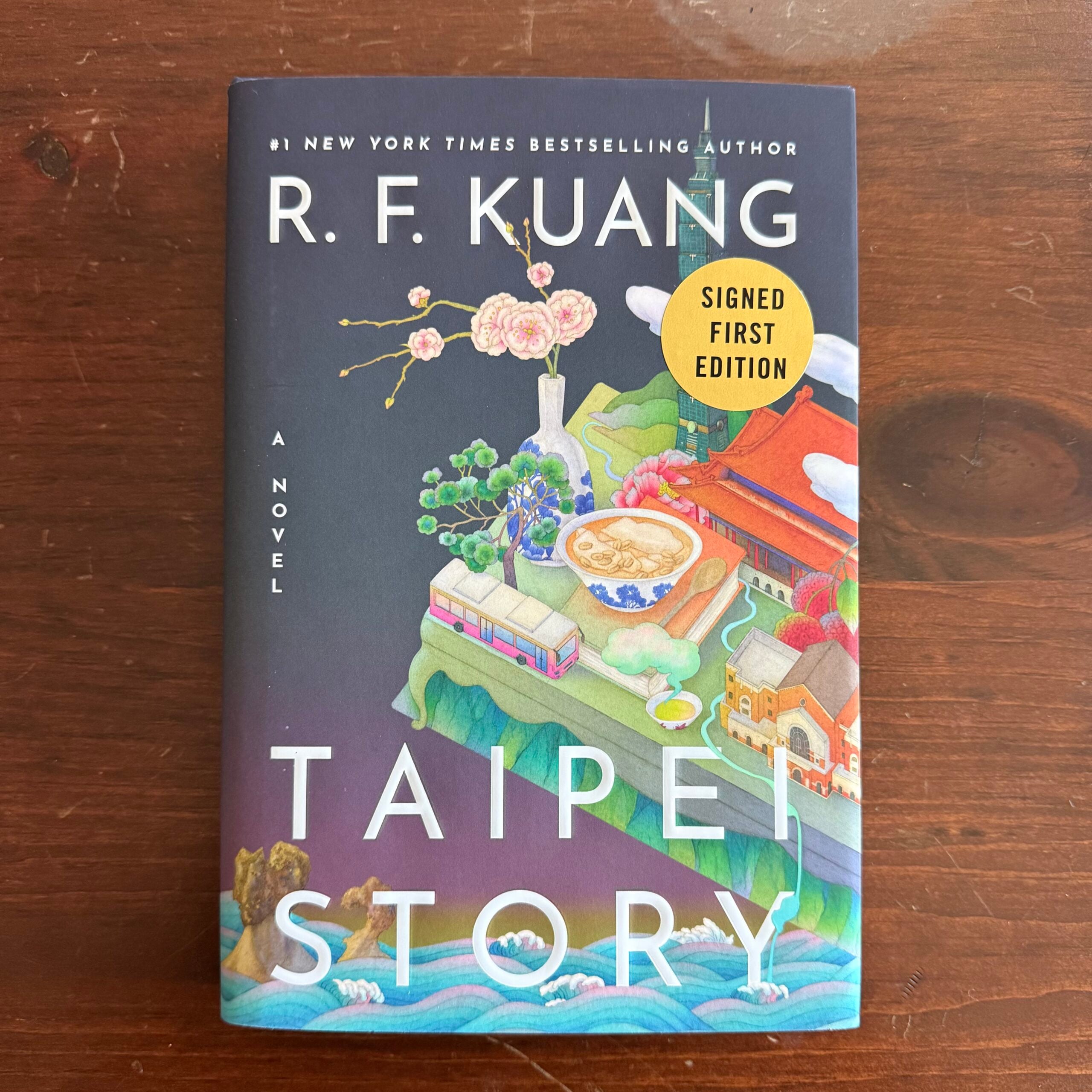
So when I heard that R. F. Kuang was releasing a book this year I was ecstatic. I put in my preorder for the deluxe limited edition as soon as it was available for preorder at Book City which was on May 22, 2026. Taipei Story is one of my most anticipated reads of the year. Especially because this was R. F. Kuang’s first foray into the world of contemporary literary fiction and I very much wanted to see what kind of story she would tell in that genre.
My preorder arrived on the books release date September 8, 2026 and I picked my order up from the Book City location the next the day. I read the deluxe limited edition hardcover (ISBN/UID – 9780063473744) published by William Morrow. The only review blurb on this edition of the book is one from The New York Times.
The Book
Taipei Story is a contemporary literary fiction novel that tells the story of college freshman Lily Chen as she travels to Taipei, Taiwan to spend a summer at an intensive Chinese language learning program at the National Taiwan University. The story starts with her flight to Taipei from Logan International Airport in Boston, MA, USA to Taoyuan International Airport in Taipei, Taiwan with a layover in San Francisco.
The entirety of the story is told from Lily’s perspective & the book uses a first person perspective for its entire duration. In addition to her interactions with other characters, large sections of the book is Lily’s internal thought processes. This is where the meat of Taipei Story is. That introspection is where the book truly shines.
Taipei Story is by far the most introspective and personal of the R. F. Kuang books I have read over the years. Reading the author biography in the inside of the book’s dust jacket indicates to me that Lily Chen is probably a self-insert character. It is at least a partial reflection of Rebecca’s thoughts and feelings.
Rebecca is currently pursuing a PhD in East Asiian Languages and Literatures at Yale where she studies diaspora, contemporary Sinophone literature, and Asian American Literature. Lily Chen is a freshman at Yale who is on this summer trip to deepen her knowledge of Chinese in the hope that she can connect with her inherited culture. Like with Rebecca’s other books, this one feels like a academic thesis paper and fictional novel wrapped up in one, with the scale tipping onto the side of the second more than the first.
Language
There is a lot happening in Taipei Story. Like with Babel this is a story about language. However, unlike Babel‘s single minded focus on colonialism, this book explores the connection between language and identity. More specifically in the case of Lily—she is seeking a connection to the diasporic cultural identity she has inherited from her parents through gaining a deeper understanding of her native tongue, Mandarin.
Taipei Story is a novel about getting things wrong: almost every encounter in the pages to follow features mistranslation, miscommunication, and misunderstanding. It especially plays with diaspora claims to authority and authenticity, and the ways Taiwan has been mythologized in both.
Author’s Note, R. F. Kuang
As Lily struggles with being in this new environment where everything is different, we see her having a hard time making new friends and we see what this form of language learning looks like for her. Her frustration with the slow progress she is making manifests with her inability to read relatively simple bits of text like the street signs in Taipei and struggling with ordering food at restaurants.
Learning Chinese in this environment is also contrasted to how Lily learned Chinese as a young child. In a series of rote recitations that impressed her teachers, parents and relatives but ultimately did not serve in teaching her the language at anything more than a very basic level.
You couldn’t learn Chinese this way. This wasn’t a lived language. This was a source of shame, an eye roll, a minute hand ticking through molasses. This was stroke orders traced a thousand times without ever leaving an imprint on our minds, and Tang poetry memorized in a blind panic in cold, musty hallways. This was words written on water.
page 93, Lily in reference to her childhood Chinese lessons
Lily develops something she calls the “exposure theory of language” or as it is usually referred to by others, immersion language learning. Lily starts walking around Taipei, trying to expose herself to the Chinese language as much as possible. Interacting with everyone in Chinese, imitating locals, the whole nine yards. Despite all this, the self-doubt remains— will she be able to sound like she was from Taipei and more importantly will she make the cultural connection she so desperately wants?
Taipei Story makes a connection to Ted Chiang’s short story Stories of Your Life and its thesis about language & the Sapir-Whorf hypothesis. What Lily ultimately yearns for is not just fluency in Mandarin but for her thought processes to be in Mandarin. She wants to think in Chinese, and she wants that change to happen as quick as possible. In Lily’s mind, the hypothesis is reality, she just needs to immerse her brain in Mandarin deep enough for said reality to apply to her.
Grief
I would have been content with Taipei Story being a story about language in relation to diasporic cultural identity. But R. F. Kuang always adds in that little extra to make things really interesting. She throws in grief into the hot mess that is Lily Chen’s Taipei summer.
Partway through the summer, Lily receives the news that her maternal grandfather has passed away. This loosens the already tenuous grip that Lily had on this hot, messy summer in Taipei and leaves her in shock. Reeling with grief at her grandfathers death, not able to go to his funeral in Guangzhou due to visa issues, she becomes even more desperate to learn about her culture and her heritage.
I wasn’t resilient enough. It didn’t matter that nothing had functionally changed about my days. It still felt like the bottom had dropped out from my world, and I couldn’t get the taste of ash out of my mouth, and when I looked at my textbooks I felt no interest in applying myself to their contents, because I couldn’t see the point of doing anything at all. All I could think about was that my gonggong wasn’t alive anymore, and I didn’t even have memories to treasure and that was entirely my fault.
page 189
Lily wasn’t the only one left reeling from this. This hit me like a Mack truck as well. I am no stranger to grief and this feeling that the book describes is one I am quite familiar with. In the months since my father’s death, the taste of ash was present, so was a certain regret. Regret about not having spent more time with him, regret about not being able to attend his funeral because this was November 2020 and international travel was not possible.
She throws herself into Stoicism as many people before her have. This is ultimately is unfruitful. The words of Marcus Aurelius become just more ash in the mouth. It does not provide her with any peace in this moment. And I didn’t expect it would. I don’t think Stoicism is a good way to deal with large traumatic events like this. Fight me Stoicism fans.
In the aftermath of this event, Lily starts interrogating her mother with the desperation of someone who has lost a thread connecting her to her culture and is unwilling to lose more. She asks about the family history, where was her grandfather when he was younger? What happened to his relatives? What happened in Cambodia? What happened?
A new frustration enters Lily’s state of mind. Her mother is unable to answer all her questions to her satisfaction. The answers lost to the forces of history and bad record keeping, genocides, wars, migrations. And, then Lily comes to a realization.
History mangled everyone. We weren’t the only ones cursed. And my personal tragedy derived not from the fact that it had happened but the fact that no one had thought to include me in this story—the child’s indignation that this was not all about me.
page 238
I think grief clouds one judgment. Everything comes filtered through that lens and it leads to a loss of perspective. Lily’s self-centred behaviour in this moment is understandable and quite forgivable. In fact, I would have been fine with Lily remaining self-centred, I think she and anyone else in her situation is allowed such behaviour in moments like this.
What is impressive here is that Lily as a character develops throughout the course of her summer in Taipei to the point where she is able to work through her grief, her sense of isolation and dissociation and come to the realization that not all about her. Is there anything else more coming-of-age than leaving misguided self-interest behind and realizing that the world does not revolve around you?
Colonialism and Geopolitics
Oh you thought we were done? Nope. As much as Taipei Story is a story about language, cultural identity, and grief—due to its contemporary nature it is wrapped up in perceptions of Taiwan’s status as a country. This is a complex issue and despite spending some time reading up on the history of the Taiwan question, I don’t feel qualified to opine on it further. Quite frankly, I don’t think I need to have an opinion on the topic.
That said, it is worth talking about how Taipei Story addresses the issue. The primary way this book talks about the Taiwan question is by way of talking about how the United States would act in case China decides to use military force to annex Taiwan. This particular lens is congruent with Lily as she is as much American as she is Chinese. That said, throughout the story, it is more other foreign students like her commenting than Lily expressing a strong opinion on the matter herself. Lily is too busy wrapped up in her own insecurities to think much of China-Taiwan-USA relations.
Taiwan’s historical status as a colony also gets a brief mention but Taipei Story does not linger too long on the topic. Like with Taiwan’s geopolitical status, Lily doesn’t really have the time to ponder the complexities of Taiwan’s colonial history under the Qing dynasty and then the Japanese. So all we get is this.
I had no framework for making sense of this. In all my history classes, we were taught that colonialism was bad and self-determination was good. The Japanese had once colonized Taiwan, so surely this meant that the Japanese were bad. But Taiwan hadn’t achieved self-determination when the Japanese left.
There was no decolonial transition here. Instead, a defeated regime came over from the mainland and put the whole island under martial rule, and now the Taiwanese were trapped between the regime that had once put them under martial rule, an authoritarian regime that wanted to absorb them into the mainland, and an imperialist regime pulling strings from across the Pacific.
Not once in modern history had Taiwan been allowed to determine its own future. Taiwan had only ever been passed from occupier to occupier—indeed, to Taiwan’s indigenous peoples, the Han Chinese themselves were occupiers. So who was I to say any occupier was better than the last?
page 118, Lily Chen on Taiwanese colonial history
There is quite a bit of historical ground covered in that quote but Taipei Story does not unpack any of it. This is perhaps for the best as the story is juggling a lot of plates already and adding the vast complexities of contemporary and historical geopolitics into the mix would do those topics a disservice. There just isn’t enough room for those themes to really breathe here.
And besides, if you want a book about colonialism and language R. F. Kuang has already got you covered. Go read Babel if you haven’t already. Rebecca covers those particular themes in greater depth in that particular story. Babel is also what I recommend as an introduction to R. F. Kuang’s signature style.
In addition to R. F. Kuang’s own writing about colonialism, she mentions several books about Taiwanese culture and history written by Taiwanese authors in her author’s note. One of which I read very recently—Taiwan Travelogue by Yáng Shuāng-zǐ, a historical fiction novel tackling the topic of Japanese colonial rule of Taiwan with a unique lens. So if Taiwan’s colonial history is something that interests you, I strongly recommend that book.
Concluding Thoughts
Taipei Story is a poignant exploration of language and its relation to the cultural inheritance of diaspora communities—it is also a coming-of-age story for Lily Chen. And like all good coming-of-age stories it is messy. Lily is a mess of insecurities, awkwardness, and the desperation to belong that is often seen in people like her. Lily went to Taipei with many questions and came out the other end with some answers and even more questions.
This is quintessentially a R. F. Kuang book, I felt that as soon as I saw her reference multiple books I have read. Rebecca is at her best when she is not just exploring complex themes in isolation but when she is in conversation with other texts that explore those topics. It shows a level of care for these topics that I don’t usually see in other fiction. Her books make me ponder and learn new things and that is one of the highest compliments I can pay an author.
Is this a book of the year? Yeah, obviously. I loved this book and for the third year in a row R. F. Kuang has put a book in my books of the year list. No other author has yet managed that and that in itself is a feat worthy of commendation. I very much look forward to what stories she will tell in the future.
That is all from me, see y’all in the next one.
Thank you for reading this blog post. Please consider supporting my writing work through Patreon. Additionally, please share this post on your socials and/or with your friends. It really helps! If you have any thoughts/feedback/thoughtful criticism to share, feel free to use the handy contact me page to send that to me.