It was different from the way she’d blushed and felt her heart beat faster around one of the older boys at the samurai academy. Different from when she’d glimpsed on of the more handsome Shimazu sons that her father said she might marry one day, before they’d lost everything. She didn’t want Lee Turner to kiss her, or marry her, or fall in love with her. She wanted him to sit beside her on this porch and watch the stars with her for as long as she was still alive. She wanted to exist beside him, to be real and whole in someone else’s eyes, to bare her soul to someone and have them stay beside her anyway.
page 271, Sen
Table of Contents
Why Japanese Gothic?
Japanese Gothic was the October book club pick for the lexi aka newlynova book club. As preparation for this I ended up reading Kylie Lee Baker’s previous novel Bat Eater and Other Names for Cora Zeng which I found to be a good read. That was my first foray into horror fiction and I wanted to dive deeper into that particular well.
I placed a paused library hold for this book a couple months ago and the library hold arrived at the beginning of October. I didn’t get around reading it immediately as I did not want to read two horror novels back to back so I read The Unicorn Hunters in between Cora Zeng and this one.
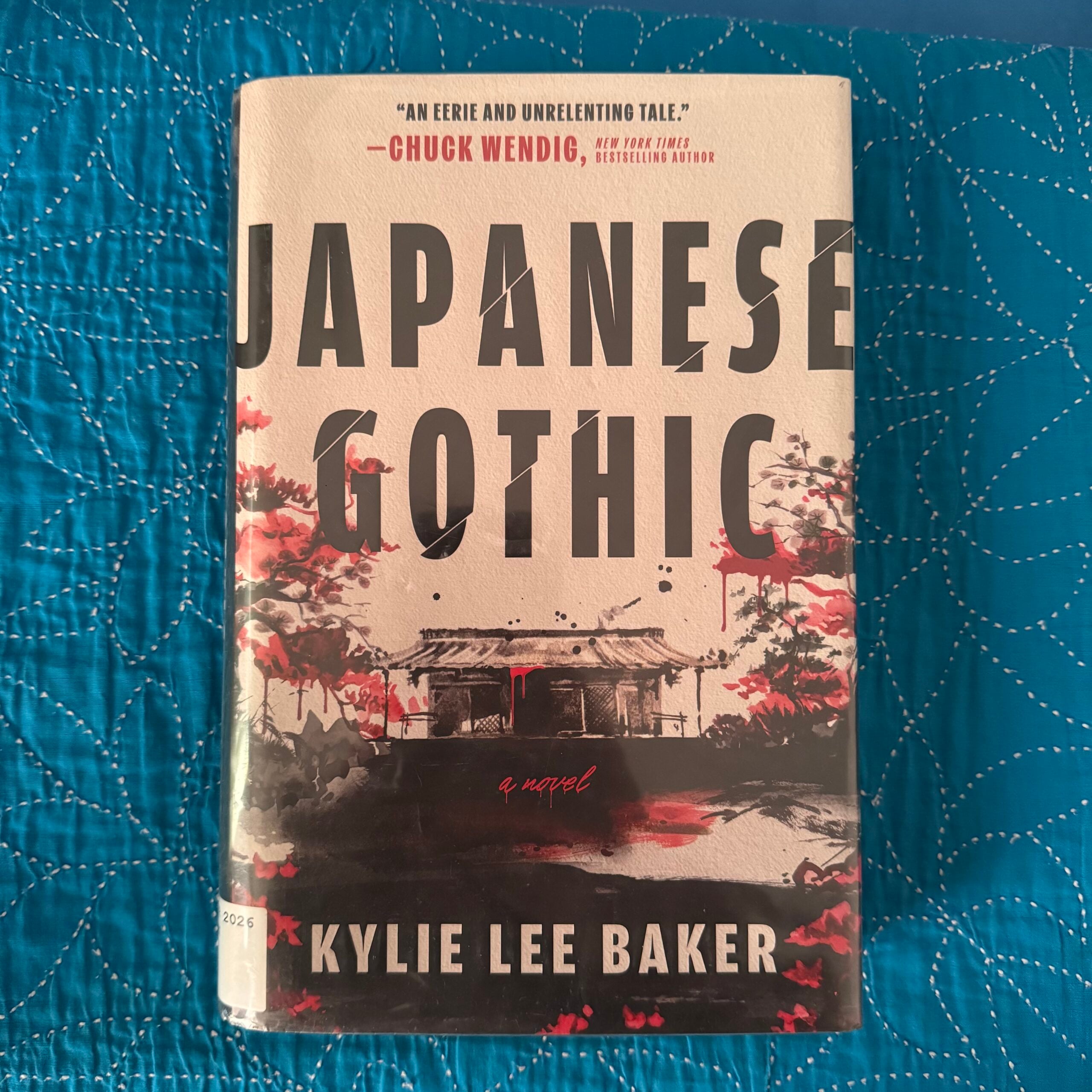
I read a hardcover edition (ISBN/UID – 9781335001559) published by Hanover Square Press in April 2026. The copy I read was borrowed from the Toronto Public Library. Author blurbs on this edition are from – Monika Kim, Marcus Kliewer, Johanna Van Veen, and Chuck Wendig.
Let’s get into it.
The Book
Japanese Gothic is a psychological horror novel with a mystery aspect that tells the story of two main characters. The first being Lee Turner, October 2026 in Chiran, Kagoshima Prefecture, Japan. The second being Sen, October 1877, Kagoshima Domain. The book switches between Lee and Sen’s perspectives chapter to chapter. I thought it quite the eerie serendipity that I happened to read this book in October 2026.
The book borrows heavily from Japanese mythology, these can be seen with the interlude chapters titled “The Legend of Urashima Tarō” which tells the mythical tale Urashima Tarō. More interesting to me is that the book also presents the samurai class and its various myths through the character of Sen’s father Iwasaki Itaro. The myths about death, samurai honor – Sen’s father clings on to all of it til the bitter end, not content with the abolishment of the samurai class that happened shortly before the events of Japanese Gothic.
The Fall of the Samurai
After the Meiji Restoration, the abolition of the domains, conscription, the commutation and abolition of hereditary stipends, and the removal of privileges such as sword-wearing dismantled the institutional basis of samurai status; former samurai feudal lords were reorganized as kazoku (nobility) along with court nobles, while most former warriors became shizoku.[6][7]
Wikipedia contributors. (2026, October 19). Samurai. In Wikipedia, The Free Encyclopedia. Retrieved 12:38, October 23, 2026, from https://en.wikipedia.org/w/index.php?title=Samurai&oldid=1380999330
The Meiji Restoration which restored imperial power in Japan happened in 1868. By 1877, which is Sen’s timeline in Japanese Gothic, the samurai resistance led by the outgoing Tokugawa Shogunate and its allies had all but been crushed. Sen’s father Itaro is referred to as a dishonored samurai who survived one of these rebellions. I believe the book is referring to the Satsuma Rebellion which happened 29 January – 24 September 1877 and resulted in a crushing defeat for the remaining samurai forces with nearly all of them killed or wounded.
The history of the Meiji Restoration is fascinating one and if you want more I recommend Isaac Meyer’s History of Japan podcast as an accessible starting point. What is relevant to a review of Japanese Gothic is that Iwasaki Itaro returns from the rebellion wars disgraced and clinging onto old traditions long after their expiration date and trains his daughter Sen in the ways of the samurai in a futile effort to preserve samurai tradition and culture for what he hoped would lead to their resurgence.
More importantly, the history of the samurai is a complicated one and it is especially complicated by the fact that Western media depictions of samurai are caricatures at best, depicting them as a honourable class of people who followed the bushido code. The historical truth is unsurprisingly a lot more nuanced than that.
I think Kylie Lee Baker understood this and Japanese Gothic is a fairly thorough and nuanced portrayal of a samurai family holding onto traditions very much to their detriment. Much of Sen’s story is about her father training her so she could protect their family when the Meiji imperial forces eventually found their little hiding spot. I’ll let Kylie explain in her own words from the author’s note at the end of the book.
It is difficult to write about the samurai for an American audience. The concepts of Bushido that defined many samurai practices (honor, loyalty, self-discipline, etc.) are now seen as stereotypical caricatures of East Asian people today, and are read as tired tropes even if accurate in their historical context. Asian people are often stereotyped as being backward and savage hive minds, and I have never wanted to support that mentality with my writing.
Author’s note, pages 339-340
However, the history of Japan and the samurai is anything but virtuous , and to paint the samurai as heroes who transcended the ethical problems of their time period would be a disservice to the many Chinese, Korean, Taiwanese, Southeast Asian, and Indigenous Ryukyuan people who were colonized and slaughtered at the hands of the Japanese government, including my own family.
As someone who very much enjoys a good samurai story, Japanese Gothic is an excellent samurai story. I think it is one of the best samurai stories I have encountered in years. I certainly wasn’t expecting this level of nuance and exploration of the samurai mindset in this novel but it delivered all that and more. So kudos to Kylie for that.
The Horror of It All
As much as I would like to keep talking about Japanese Gothic‘s connections to Japanese history, I think I also need to talk about the horror elements of this book. Like with Kylie’s previous book Bat Eater and Other Names for Cora Zeng, this is also a ghost story with the difference this being that it is not clear who is the ghost.
That is where the mystery aspect of this book comes in. Like the Storygraph description of the book mentions, it is not clear what is “real” or not in this story. It is not clear if Lee, Sen, or any of the other characters like Lee’s father, his girlfriend Hina or any of Sen’s family members are ghosts or actual people. Lee himself is increasingly an unreliable narrator and throughout the book I could never quite get a grip on what was happening, it felt like I was losing my mind just like Lee was.
If I had to pick one word to describe the horror that this book invokes, it is confusion. The confusion generated by not knowing that what you are seeing with your own eyes or hearing with your ears is real or not. Not being able to distinguish dreams from reality, now that is quite terrifying indeed. The book kept me in a constant state of confusion until the very end and that very confusion motivated me to devour the book in a couple days because I really wanted to know just what the fuck was going on.
Kylie Lee Baker continues to get better at creating a sense of atmosphere and this book is even better at it than Cora Zeng was. Her somewhat lyrical style of prose enhances the psychological horror of Japanese Gothic and builds a well…gothic atmosphere that I was fully immersed in at all points. I could easily visualize the scenes – the house hidden by sword ferns, the interior of the house, Sen practicing with her katana, all of it.
Concluding Thoughts
I very much enjoyed my time reading Japanese Gothic. I think it is now the best horror novel I’ve read. And, I think that I am definitely in the psychological horror enjoyers camp now. While this book has moments where it has classic physical horror elements, for the most part Kylie uses her ample skill at creating an immersive atmosphere to terrify the reader instead, the monster is in your head and not chasing you down in a samurai house.
I want to read more horror like this from Kylie Lee Baker. She has a book coming out in March 2027 called Hell to Pay and I think I am going to ahead and place a pre-order for that book after I finish writing this review.
That’s all from me, see y’all in the next one.
Thank you for reading this blog post. Please consider supporting my writing work through Patreon. Additionally, please share this post on your socials and/or with your friends. It really helps! If you have any thoughts/feedback/thoughtful criticism to share, feel free to use the handy contact me page to send that to me.