They would imagine how they must to look to the outside world with their aching cheekbones drawn into fixed grins, their clothes smeared with cigarette ash and sweat, and still carrying the odd trace of dimly remembered adventures: a marker pen scribble on their face; a garland of fake frangipani in their pocket; a bunch of helium balloons tied to their jacket buttons and now trailing, half-deflated, like comet tails. They would feel decadent and enviable, alive.
page 35
Table of Contents
Why Perfection?
I first heard mention of Perfection from a blog post on V.H. Belvadi’s blog at the end of October 2026. At the time I didn’t pay it much mind though I did note somewhere in my brain that it was a piece of translated fiction and potentially something I should read at some point.
Fast-forward to mid-November I was getting started on Ursula K. Le Guin’s writing craft book Steering the Craft and doing writing exercises from it. I was discussing the writing exercises with my friend Chloe who recommended Perfection as a book that had exemplary scene descriptions and as such would be helpful to my writing craft improvement efforts.
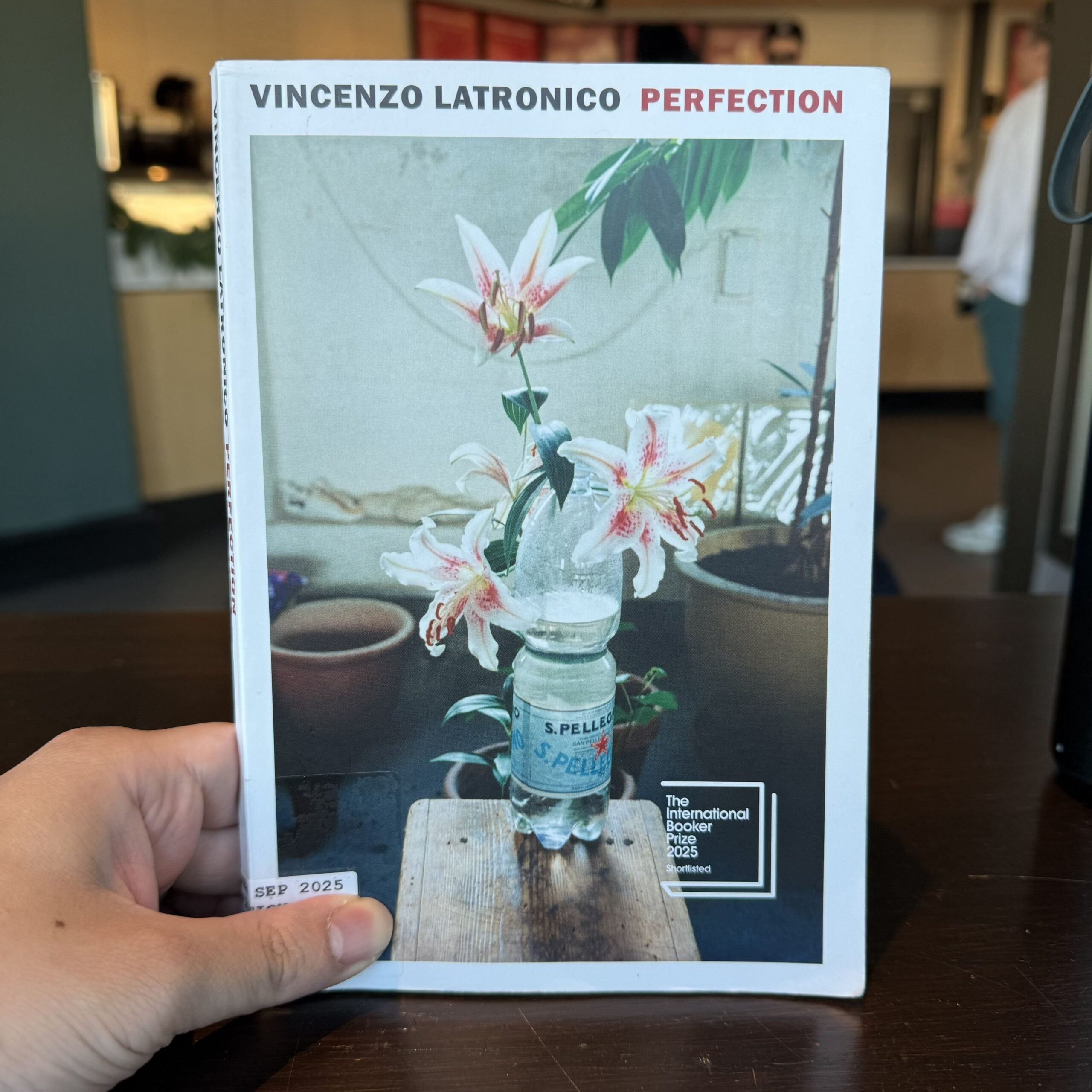
I put in a library hold for the book and the hold arrived shortly after that. I ended up reading the entirety of the book this past Sunday over one sitting in a cafe with the generous help of a flat white. I read a paperback edition (ISBN/UID – 9781681378725) of the book published in September 2025 by The New York Review of Books.
Perfection is translated from the original Italian by Sophie Hughes. Review blurbs on this edition of the book are from Lauren Oyler and Kathryn Davis. This book was also shortlisted for the 2025 International Booker Prize.
Let’s get into it.
The Book
Perfection is a literary fiction novel that tells the story of Anna and Tom, an expat couple, in their mid-30s living in Berlin. They are so-called digital nomads, their jobs as “creative professionals” can be done from anywhere with a laptop and good wi-fi. The story is told from a third-person perspective with a detached author narrator voice which significantly enhances the book’s scene descriptions. Allow me to quote one of these descriptive passages; this is the first paragraph of the book.
Sunlight floods the room from the bay window, reflects off the wide, honey-colored floorboards, and casts an emerald glow over the perforate leaves of a monstera shaped like a cloud. Its stems brush the back of a Scandinavian armchair, an open magazine left face down on the seat. The red of that magazine cover, the plant’s brilliant green, the petrol blue of the upholstery, and the pale ochre floor stand out against the white walls, their chalky tone picked up again in the pale rug that just creeps into the frame.
page 5, Present
The description of this Berlin apartment goes on like this for a total of five pages and I loved every bit of it. That is a rarity in itself, in most cases large tracts of descriptive prose bore me because it feels like the author is wasting my time. Not so here. The way Vincenzo describes this apartment makes it extremely easy to to visualize and it also makes the thematic thrust of this book hit harder. This is how the book continues to describes Anna & Tom and the environments they move around it; though the book tones down the descriptive prose just a tad to allow for the two main characters and their actions to shine.
Ennui
When they weren’t busy moving apartments, Anna and Tom spent much of their first year in Berlin carefully constructing this mythology. And it wasn’t personal to them; its value lay precisely in its universality. It was a mythology shared by all the Spaniards, French, Italians, and Americans they met. It was the topic of countless lifestyle articles and documentaries, and circulated on the Facebook timelines and Instagram feeds of an entire generation. It was the admission stamped into a community bound by a shared reality, or quasi-reality.
page 21-22
If there was one word I had to pick to describe what Perfection is about it would be: ennui. The homogeneity of perfection, of cozy consumerism and the astronomical amounts of alienation that comes with living such a consumerist lifestyle. Anna & Tom’s lives in Berlin are depicted as picture-perfect—Instagram-worthy lattes in cafes with good wi-fi, eating good food in good restaurants, going to museums and art galleries, spending the occasional late night at a Berlin sex club. Hedonistic, shallow, and ultimately unfulfilling.
Anna & Tom’s jobs also leave them unfulfilled, they are ostensibly doing what they love and what they are good at—web developer, graphic designer, brand strategist. And yet, the precarious nature of their freelance gigs leave them constantly in a state of anxiety, in the beginning rent is relatively cheap but their income sources are not stable. They start supplementing their unsteady incomes by becoming landlords—in the AirBnB kinda way. They clean up the mess in their apartment and present the perfection so desired by other digital nomad expats looking to live the lifestyle they see on Instagram. They capitalized on the universality of the mythology that they themselves had fully built their lives on.
I found this exploration of ennui to be mildly disconcerting to read as I found it echoing the alienation I feel living and working in a capitalist society. While I don’t live the same kind of digital nomadic lifestyle that Anna & Tom do, it is something that on the surface seems desirable if I don’t think too much about the side-effects that such a lifestyle has on the people living it and the cities that get hit by the storm of digital nomads seeking cheap food and rent. The perfection is a myth and this book made sure I remembered that.
Gentrification
In the second half of the book, Perfection deals in irony. As the years pass by, the very Berlin neighbourhoods that Anna, Tom and people like them gentrified go through another round of gentrification. Rents go up, cheap, cozy cafes get replaced by expensive, bland ones. The facade of Anna & Tom’s life starts to fall apart; so they decide to uproot themselves from Berlin and head to Lisbon; when Lisbon doesn’t quite work out like they wanted they go to the Italian countryside and then finally they end up in a different place at the end of the story.
Through these circular plot threads, Perfection tells us of the futility of trying to continuously create the “perfect” live for ourselves; the futility of holding onto consumerist ideas of what a good life is supposed to be instead of enjoying life more holistically. The detached authorial narrative voice here allows us the reader to process Anna & Tom’s lives without Vincenzo’s judgment of them guiding our thoughts. It gives the themes space to percolate in your brain.
This book uses structural repetition to great effect, not only through the repeating cycles of gentrification but also in the way Anna & Tom themselves take pictures of themselves in an airport, first on their arrival in Berlin and then upon leaving it. They think to themselves that they have changed as people which they have. But they don’t realize that they continue to be stuck in a downward spiral, still chasing that perfection.
Migration
Perfection also tries to explore the topic of the so-called European migrant crisis; the crisis being that a large number of Europeans are racist, selfish assholes who wouldn’t know the meaning of “love thy neighbour” if a copy of the Bible hit them in the face. There is a relatively brief section of the book where a large group of Syrian refugees settle in Anna & Tom’s Berlin neighbourhood and we see them try to help these refugees and completely fail at it, they have no skills that would be helpful, they don’t speak Arabic, they barely speak German and ultimately they end up stopping their futile efforts and forgetting about the refugee situation in their city.
This bit of the book is one of the few weaknesses of Perfection; mostly because the book doesn’t explore the topic in as much depth as I would prefer. That said, I think it shows that as much as Anna & Tom pretend to be socially conscious individuals, when push comes to shove they retreat back to their selfish, miserable lives and forget that they ever tried to be better people. They know that signalling such virtue is good for their public image but they lack the moral foundation to actually follow through with it long term. Like with other aspects of their lives, this is also a form of self-mythologizing.
Concluding Thoughts
I enjoyed my time reading Perfection. It was a short, well written exploration of capitalist alienation through the lens of the digital nomadic lifestyle and the subsequent gentrification it creates. From a craft perspective, I thought that the book made great use of its detached authorial narrative voice alongside exquisite scene description prose. It was also a great lesson on how to effectively use structural repetition to really drive the point home. It is no surprise that this book was shortlisted by the International Booker Prize.
I am very glad that Chloe recommended this book to me. Dear reader, if you know of other books like this, please share your recommendations with me. Bonus points if they are translated fiction. I will leave y’all with one final quote.
Back in the day, looking at images like those and knowing how frustrated and unhappy they had been when they took them feel ashamed, deficient, as if the reality presented in the photos should somehow be capable of triumphing over how they really felt, and their inability to enjoy such a desirable life revealed a flaw in their character. They had outgrown this insecurity. Now those images just seemed like a con.
page 115
They were oh so close to getting it. Stay warm, don’t be like Anna & Tom. I’ll see y’all in the next one.
Thank you for reading this blog post. You can support my writing work through Patreon. Additionally, please share this post and/or subscribe to the RSS feed in your RSS feed reader. If you have any thoughts/feedback/constructive criticism to share, feel free to use the handy contact me page to send that to me.