Everyone knew that the nicer a library was, the better the work you did within it. Nice libraries meant donors, meant support, meant the time and resources to accumulate the best collections. More important, nice libraries put you in a certain frame of mind. You could unpack the precise same set of archives in the Rad Cam or a nondescript warehouse, and still you’d do better work in the Rad Cam. The atmosphere mattered. You became the thinker the library expected you to be. Nice libraries whispered: Everyone who has passed through here is very important, and so are you.
page 83, Katabasis by R.F. Kuang
Table of Contents
Preamble
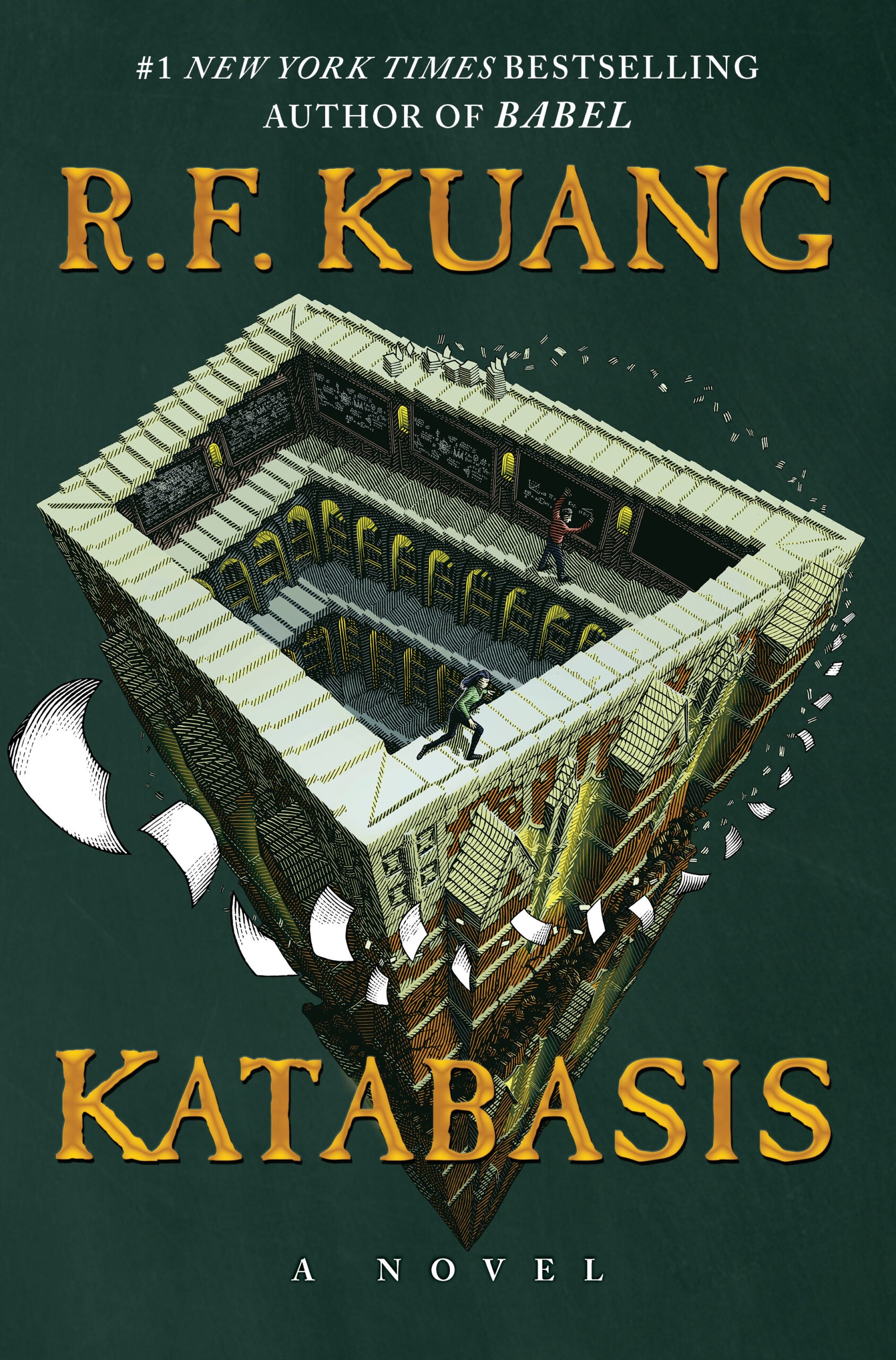
I have been hearing about R.F. Kuang’s latest book Katabasis for about five months now, it seems ARCs (Advance Reader Copies) for Katabasis were made available back in March 2025, at least to a select few. cari’s first impressions back then were not all that positive which instilled a sense of trepidation in me at the time.
I didn’t end up hearing about the book until after it had come out on August 26th, 2025. This time I heard about it from the wonderful lexi aka newlynova who did a spoiler free vlog & review of the book which got me interested in reading the book again. lexi mentioned that if one had enjoyed Babel, then one is going to enjoy this book as well.
I am one of those people who enjoyed Babel a great deal and it ended up being one of my books of the year for 2024. So this past weekend, I headed down to the Book City location in the Beaches and picked up a deluxe limited edition of Katabasis as a little treat for myself. I was debating the choice between a cheaper Kobo ebook copy or a hardcover physical copy at double the cost and lexi’s thoughts led me to making the latter choice.
I think this limited edition of Katabasis has the best sprayed edge design I have seen in a while. Normally the sprayed edges I see on physical copies of books are one solid colour matching something about the book itself. On this one, someone actually took the time and effort to design a pattern that looks really cool. I am glad I picked up a physical copy of this book. So here are some photos of what it looks like.


Now, let’s get into the book itself.
The Book
Katabasis is a historical fiction novel in the dark academia sub-genre. Dark academia is a genre I am not generally familiar with; the only other book I can think of that could fall into this category is another of R.F. Kuang’s books Babel. To me dark academia means a story which uses academia and/or an academic setting to tell a compelling narrative with serious and “dark” themes.
Fundamentally, I think that Katabasis is a character study at its core. While Babel had interesting characters, its narrative was more focused on exploring the themes of colonization and anti-colonial violence and the characters were vehicles for said themes. This book explores its themes using a character study as the vehicle which means we get a lot more focus on the main characters than we did in Babel.
The Storygraph description for this book compares it to Dante’s Inferno and Susan Clarke’s Piranesi. While I think the Inferno comparison is apt since the book mostly takes place in Dante’s version of Hell, the Piranesi comparison is much less so. The only way this book is comparable to Piranesi is that it takes place in a weird world that is not our own. It doesn’t really have any of the disassociation vibes that Piranesi had.
Themes
Thematically this book is primarily focused on academic trauma, the kind of trauma that is inflicted when one descends into the hell of academic asceticism, forsaking physical and mental health needs in pursuit of the needs of the mind. Sprinkled in is also an exploration of the rampant misogyny and sexism that was present in 1980s higher education which Alice has a harrowing set of experiences with.
Professor Grimes was the most fanatic about his asceticism. “To learn is the most godlike thing we can do,” he told them. He had given them this lecture in their first years, back when they were foolish enough to think they could make time for things like sleeping or seeing movies. “Humans, unlike animals, are born with the faculty of reason. This places us above beasts, and near to God. And so as Aristotle says, we ought to be pro-immortal, and go to all lengths to live a life in accord with our supreme element. The life of the mind is all there is. Anything else is degeneracy, is bodily, is filth.”
page 130, Katabasis by R.F. Kuang
This is dark academia fiction with a significant emphasis on the dark. The book does not pull any punches, it is heavy reading and prospective readers would do well to heed the content warnings for suicidal ideation, sexual harassment and chronic illness. I think all the themes present were tackled in a reasonably nuanced way that I have come to expect from R.F. Kuang after having read Babel.
Characters
The story revolves around two main characters – Alice Law and her rival Peter Murdoch – who both decide to make the journey into Hell to save Professor Jacob Grimes. Both our main characters are graduate students studying analytic magick (yes it is spelled that way in the book) at the University of Cambridge in the 1980s.
The story switches timelines between Alice’s past experiences at the university and her present experience in Hell. It uses this timeline switch to not only make a point about how university was a kind of hell all by itself but it also paints a portrait of a very traumatized person who has been subjected to not only the physical and mental rigours of graduate studies but also an abusive, manipulative advisor in Professor Grimes.
While the beginning half of the book is mostly focused on Alice, in the second half, the book explores Peter’s experiences at university and it paints a very similar set of experiences. Alice’s academic trauma takes the form of abuse, manipulation, misogyny and bad self care. Peter’s trauma takes the form of ignoring his Crohn’s disease and using maladaptive techniques learned as a child to get by. At the same time, Grimes is manipulating them both and pitting them against each other. It is a kind of hell.
How good it felt when she seemed to abandon her body altogether-when she became fully incorporeal, drifting happily in a universe of ideas. She was very proud of the days that she forgot to eat. Not because she had any revulsion for food, but because it was some proof that she had transcended some basic cycle of need. That she was not just an animal after all, held captive by her desires to eat and fuck and shit. That she was above all a mind, and the mind was capable of miraculous things.
page 261, Katabasis by R.F. Kuang
I found these two characters quite compelling. Especially Alice who slowly comes to understand just how traumatic her academic career and her coming to grips with that throughout the story makes for some very emotionally impacting character development.
My time in academia was fairly short lived, I dropped out before I could get an undergraduate degree. That short time however was quite miserable for me – I was lonely, tired, sleep deprived, depressed, burned out and reading this book’s take on academic trauma was a kind of catharsis I had not gotten from a book before. It felt very authentic, like R.F. Kuang was writing from her own experience as an academic. At times I wondered if Alice Law was a self-insert character. It wouldn’t surprise me if she was.
The Nerd Shit
Katabasis is the nerdiest book I have read in a long time. I mean that as a compliment. This book is R.F. Kuang fully flexing her academic muscles and indulging in talk of a lot of extremely nerdy shit. I am talking – philosophy, logic, set theory, paradoxes, and mythology. This book’s got it all.
Theories of reincarnation overlap nicely with theories of eternal recurrence, an idea championed by both Friedrich Nietzsche and the Pythagoreans. Broadly understood, eternal recurrence argues that the events of the universe are fated—or doomed-to repeat themselves over and over again, for there is a finite amount of energy and material in an infinite universe, over an infinite amount of time, and the combinations with which they can interact are finite as well. The eternal hourglass of existence, so to speak, turns over time and time again. We are reborn to flow with the sand.
page 79, Katabasis by R.F. Kuang
My notes for this book in my Capacities notebook is filled with links to Wikipedia, links for Dante’s Inferno, Linear B, The Cowherd and the Weaver Girl, liar paradox, dialetheism, and Gödel’s incompleteness theorems just to name a few. It made me want to actually read The Divine Comedy. In general, this book stimulated my intellectual curiosity in a way that most other fiction books do not. My brain was positively buzzing reading this book.
A common criticism of this book and of R.F. Kuang’s work is that she is a little too heavy handed with the references or perhaps they are over-explained rather than woven into the story in a natural way. While I can see where those criticisms are coming from, I enjoyed reading the explanations of the various philosophical and logical concepts bought up in this book.
I think this is because I am not familiar with most of the nerd shit this book this talking about so I found the explanations a helpful jumping off point for my own curiosity rather than onerous explanations of things I already knew. The book also never takes on a condescending tone explaining these things. In fact, there is a lightly joyous tone to them. The explanations felt written by someone who genuinely is into logic, philosophy, and mythology and would like to explain these concepts and how they fit into the book’s narrative to the reader.
An Aside About Mythology
Katabasis borrows from a few different mythologies for its mythological mix. The title of the book is the Ancient Greek word for a journey into the underworld.
A katabasis or catabasis (Ancient Greek: κατάβασις, romanized: katábasis, lit. ‘descent’; from κατὰ (katà) ‘down’ and βαίνω (baínō) ‘go’) is a journey to the underworld. Its original sense is usually associated with Greek mythology and classical mythology more broadly, where the protagonist visits the Greek underworld, also known as Hades.
Wikipedia contributors. (2025, August 14). Katabasis. In Wikipedia, The Free Encyclopedia. Retrieved 12:14, September 12, 2025, from https://en.wikipedia.org/w/index.php?title=Katabasis&oldid=1305849495
There are other references and characters from Ancient Greek mythology as well – the Erinyes aka the Furies make a brief appearance. As someone who has played the video game Hades I visualized the Erinyes as they are depicted in the video game instead of the form they take in this book. Our main characters enter Hell through the Asphodel Meadows. Cerberus also makes a brief appearance and the Lethe river is an important part of the narrative.
The book also borrows from Chinese and Buddhist mythology – the Weaver Girl from folktale The Cowherd and the Weaver Girl makes an appearance. The king of the underworld takes the form of Yama. I think this syncretism works really well, the Weaver Girl or Yama didn’t feel out of place compared to the rest of the characters and mythologies of the Hell in this book.
Conclusions
Katabasis is R.F. Kuang back on her bullshit and I fucking love it. This book is an intriguing character study that explores some dark and heavy themes with the requisite amount of nuance. It uses a journey through Dante’s Hell as an extended metaphor for the exploration of the main characters’ academic trauma in a way that I found to be cathartic.
When I finished the book, I had some initial criticisms about how the book was paced, namely that the section in Dis seemed unnecessary to the narrative but upon further reflection I think it explores the way that trauma can create a mental stagnation that can be hard to exit and as such it was quite relevant to the arc of Alice’s character development.
I don’t have any significant criticisms of the book and it will be one of my books of the year for 2025. Two years in a row that a R.F. Kuang book has been in my in books of the year list, that is quite the accomplishment. At some point next year I want to go back in her catalogue and read Yellowface and The Poppy War trilogy which I haven’t read yet.
I’ll echo what lexi said in her video, if you enjoyed Babel, I think you’ll enjoy Katabasis. On the other hand, if you really don’t like R.F. Kuang’s writing style and have not enjoyed her books previously, this will not change your mind.
That’s all I’ve got for y’all this time. See y’all in the next one.
P.S: A classical music playlist is perfect accompaniment for this book. I used the Classical Concentration playlist on Apple Music. Additionally, the blogger Howard Oakley has a series on the paintings that came out of Dante’s Inferno beginning with an introduction. Use the search function on his site with the phrase “Dante” to find the other posts. There are some very striking paintings in there. I am considering buying a copy of The Divine Comedy with Gustave Doré‘s illustrations in them.
Thank you for reading this blog post. Please consider supporting my writing work through Patreon. Additionally, please share this post on your socials and/or with your friends. It really helps! If you have any thoughts/feedback/thoughtful criticism to share, feel free to use the handy contact me page to send that to me.