As we walked arm in arm in this merry mood, wind brushed against our cheeks–a wind strong enough to lift bougainvillea blossoms off their branches. Did that mean we, too, were characters in a shojo romance?
page 129
Table of Contents
Why Taiwan Travelogue?
I first found out about Taiwan Travelogue when I saw the news about it winning the 2026 International Booker Prize. Three things about it intrigued me. First, it is a work of literary fiction, I continue to be interested in reading more literary fiction. Second, it is translated fiction, another type of fiction that I want to read more of. Third, it is fiction that deals with the complicated relationships between colonizer and colonized in a setting I have not read in fiction before.
All three things combined meant that I placed a library hold for this book in May 2026. The Toronto Public Library system had very few copies and while they had placed orders for more, the book was out of stock from suppliers and I presume the publisher had to order a new print run of the book to meet the spike in demand that the prize winner announcement created.
I had to wait till early August till I could get my hands on a copy of the book. I ended up buying a physical copy of the book through Book City who had received new stock. My library hold was still moving quite slowly and the system had not received the additional copies it had ordered and I was losing patience so a purchase it was.
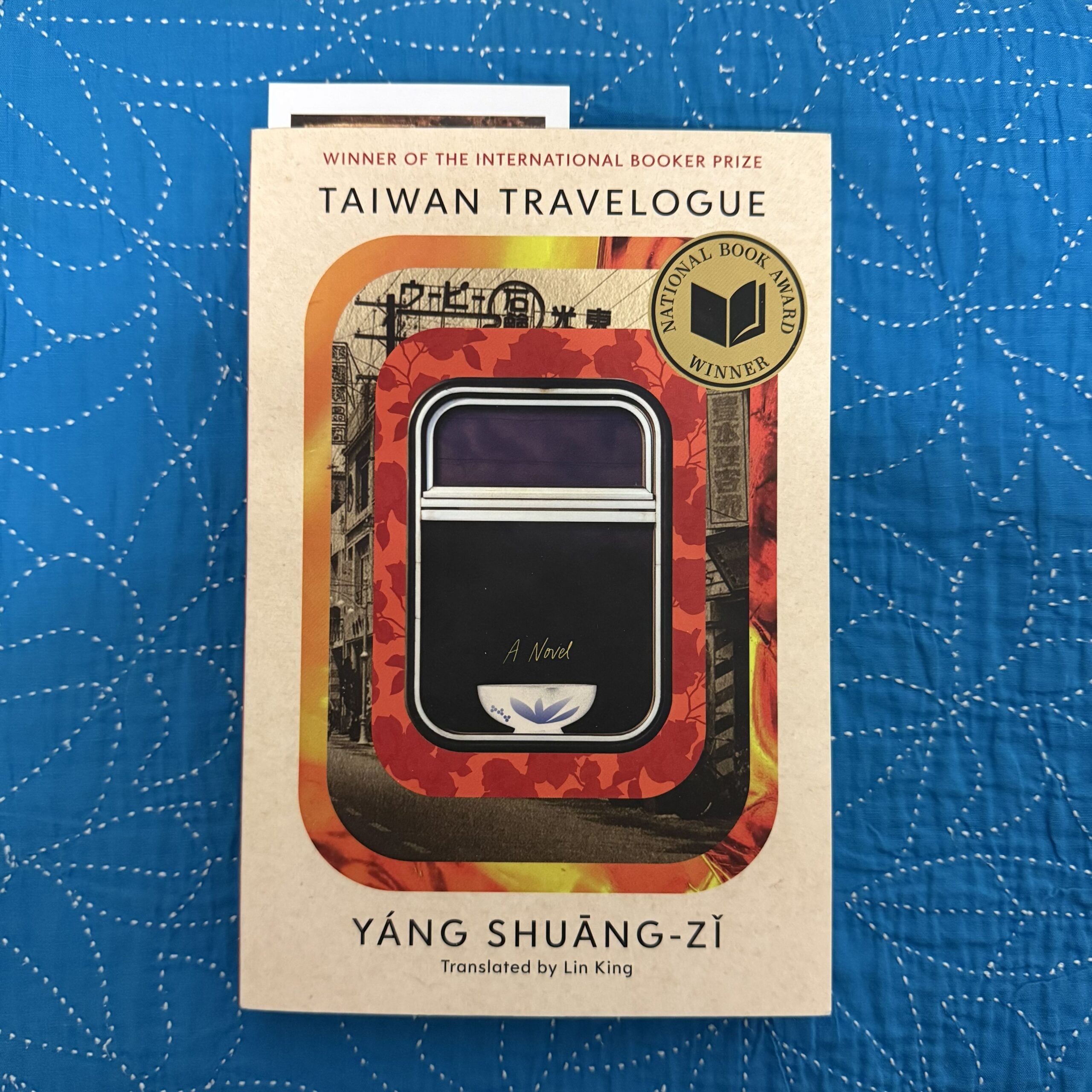
I read a paperback edition (ISBN/UID – 9781644453155) published by Graywolf Press. Physically speaking, this is the most decadent paperback I have read in a while. The quality of the cover material is excellent and has a certain weight and feel to it reminiscent of pricier hardcovers. The paper that the text was printed was also on a higher quality of paper than I usually see in paperbacks.
Let’s get into the book.
The Book
Taiwan Travelogue is a translated (Mandarin Chinese to English) literary fiction novel set in 1938 Taiwan aka a Taiwan still under Japanese colonial rule. Japanese colonization of Taiwan started in 1895 and ended in October 1945 after World War 2 had ended and Japan had surrendered to Allied forces.
The main character of the novel (and the POV character), Aoyama Chizuko, a young Japanese novelist sails from her home in Nagasaki, Japan to Taiwan upon an invitation from the Japanese government who wants to use the writer to further their imperialist agenda in the form of writing propaganda which Chizuko is not interested in.
Upon arrival in Taiwan she meets a Taiwanese woman—Ông Tshian-hoh or Ō Chizuru in Japanese who is hired as her interpreter and really an assistant in satiating Chizuko’s monstrous appetite. You see, Aoyama Chizuko is a huge foodie and large chunks of this book are spent on exploring the intricacies of Taiwanese cuisine.
An Exploration of Colonial Power Dynamics
What follows is a meditation on the nature of colonial power dynamics, specifically through the lens of Chizuko and Chizuru’s relationship as they travel together throughout Taiwan taking in the various forms of Taiwanese cuisine. Taiwan Travelogue uses this lens very effectively to delicately dissect the more benevolent paternalism inherent to the colonial mindset.
This is explored through Chizuko’s growing desire to bring Chizuru with her back to Japan to save her from her impending marriage to a man. It is in the noh mask of expression Chizuru puts on while deferring to Chizuru and her needs, trying to keep a professional distance from Chizuko while Chizuko remains baffled as to why Chizuru won’t open up to her until the end of the book.
[..] the colonial land of Taiwan did indeed have its own nuanced, established, unique, and finely crafted Taiwanese cuisine.
page 225
It is lines like the one from the quote above that subtly remind you that Chizuko is indeed the colonizer her despite her dislike of more “brutal” forms of Japanese colonization. And, in case you didn’t get the subtle hints of colonial paternalism through Chizuko’s infatuation with Taiwanese cuisine and Chizuru, the book makes it amply clear with quotes like the ones below.
The truth is that gentle Aoyoma-san never once asked me: Do you want this protection?
page 229, Chizuru to Chizuko
And yet, the way in which you talk about the Island’s flavors does not sound to me like you are appreciating them for being delicious, but more for being exotic, as one might appreciate a rare animal. It is only natural for Aoyama-sensei to pay attention to the things that rouse your interest and are novel to you, but then to claim that your personal preferences are proof of some greater trend in the relationship between the Empire and the Island seems to me forced and, pardon my frankness, a sign of intellectual arrogance.
page 245, Mishima to Chizuko
I was quite fascinated by the amount of food talk there is in Taiwan Travelogue and I ended up learning quite a lot about Taiwanese cuisine. This is perhaps not the book to read if you are hungry because almost all of the food sounded delicious and something I want to try at some point in my life. Especially that braised pork rice. That sounds heavenly.
Taiwan Travelogue also weaves in other aspects of cultural difference between Chizuro and Chizuko, such as their clothing, the way each is treated by other Japanese and Taiwanese on the island. There are multiple instances of Chizuro being treated poorly until Chizuro steps in on her behalf and displays the benevolent paternalism I mentioned earlier.
A Bittersweet Love Story
“You are quite right. Even though I cannot open my heart, the feelings that I hold within this shuttered heart are, nonetheless, real.”
page 268, Chizuru to Chizuko
The StoryGraph description of this book describes this book as a “bittersweet story of love between two women” and that is indeed the case. Bittersweet because the power dynamics between colonizer and colonized creates this barrier between the two women. Their love for each other was a real love and not just a one-sided infatuation but the colonial power dynamics was always a toxic presence in their relationship.
It is also bittersweet because I kept thinking “what if”, what if these two women had met in different circumstances where they were equals? What if they had a very wholesome friends-to-lovers arc involving a whole lot of Taiwanese food, falling in love with each on long train rides and in between conversations, soft glances at each other. What if? The question posed in the opening quote in this review is what I wished for these two women.
Thoughts on the Translation
I also liked the translation itself, I thought that the prose felt natural and carried the right amount of emotional depth. Sometimes I find translated texts to be rather clinical when it comes to emotional expression, and that is very much not the case here. I also enjoyed the various translator’s notes that appeared as footnotes, they provided much needed context for various foods, concepts, words, references to poetry and other bits of art.
I also found this bit from the translator’s note at the end of the book to be hilarious.
Lastly, I would also like to thank Miura Yüko, the Japanese translator of Taiwan Travelogue. Her translation, published by Chüököron-Shinsha in 2023, was of great help to me for factchecking my Japanese transliterations of names and places. Surely Aoyama and Chi-chan would be tickled by this: a Taiwanese translator, while bringing the book to the ultimate colonial language of English, has struggled to determine how the Japanese colonial government would have pronounced Taiwanese terms and therefore consulted the Japanese translation of a Taiwanese novel that claims to be a Taiwanese translation of a Japanese novel. Oh dear oh dear oh dear!
page 293, Translator’s Note to Taiwan Travelogue, English Edition, 2024 by Lin King
Concluding Thoughts
I enjoyed reading Taiwan Travelogue quite a bit. I loved the way the book’s depiction of the subtleties of relationships between colonizer and colonized, and especially when it comes to a more intimate relationship like those that Chizuko and Chizuru developed over the course of the book. I also very much enjoyed learning about Taiwanese cuisine and I now have a whole new list of food I want to try.
This is my first time reading anything by Yáng Shuāng-zǐ and I definitely want to read more of her fiction in the future. I also very much appreciate the quality of the translation on display here from Lin King. I think this is now the best work of translated fiction I have read in my life. I hope more of Yáng Shuāng-zǐ’s fiction is translated by Lin in the future.
That’s all from me, see y’all in the next one.
Thank you for reading this blog post. Please consider supporting my writing work through Patreon. Additionally, please share this post on your socials and/or with your friends. It really helps! If you have any thoughts/feedback/thoughtful criticism to share, feel free to use the handy contact me page to send that to me.