And what of the museums, of which Europe is so proud? It would have been better, all things considered, if it had never been necessary to open them. Better if the Europeans had allowed the civilisations beyond the Continent of Europe to live alongside them, dynamic and prosperous, whole and unmutilated. Better if they had let those civilisations develop and flourish rather than offering up scattered limbs, these dead limbs, duly labelled, for us to admire.
After all, by itself the museum is nothing. It means nothing. It can say nothing. Here in the museum, the rapture of self-gratification rots our eyes. Here, a secret contempt of others dries up our hearts. Here racism, no matter if it is declared or undeclared, drains all empathy away. No, in the scales of knowledge the mass of all the museums in the world could never outweigh a lone spark of human empathy.
Aimé Césaire, Discours sur le colonisalisme, 1955 (Dan Hicks’ translation)
Table of Contents
Why Relooted?
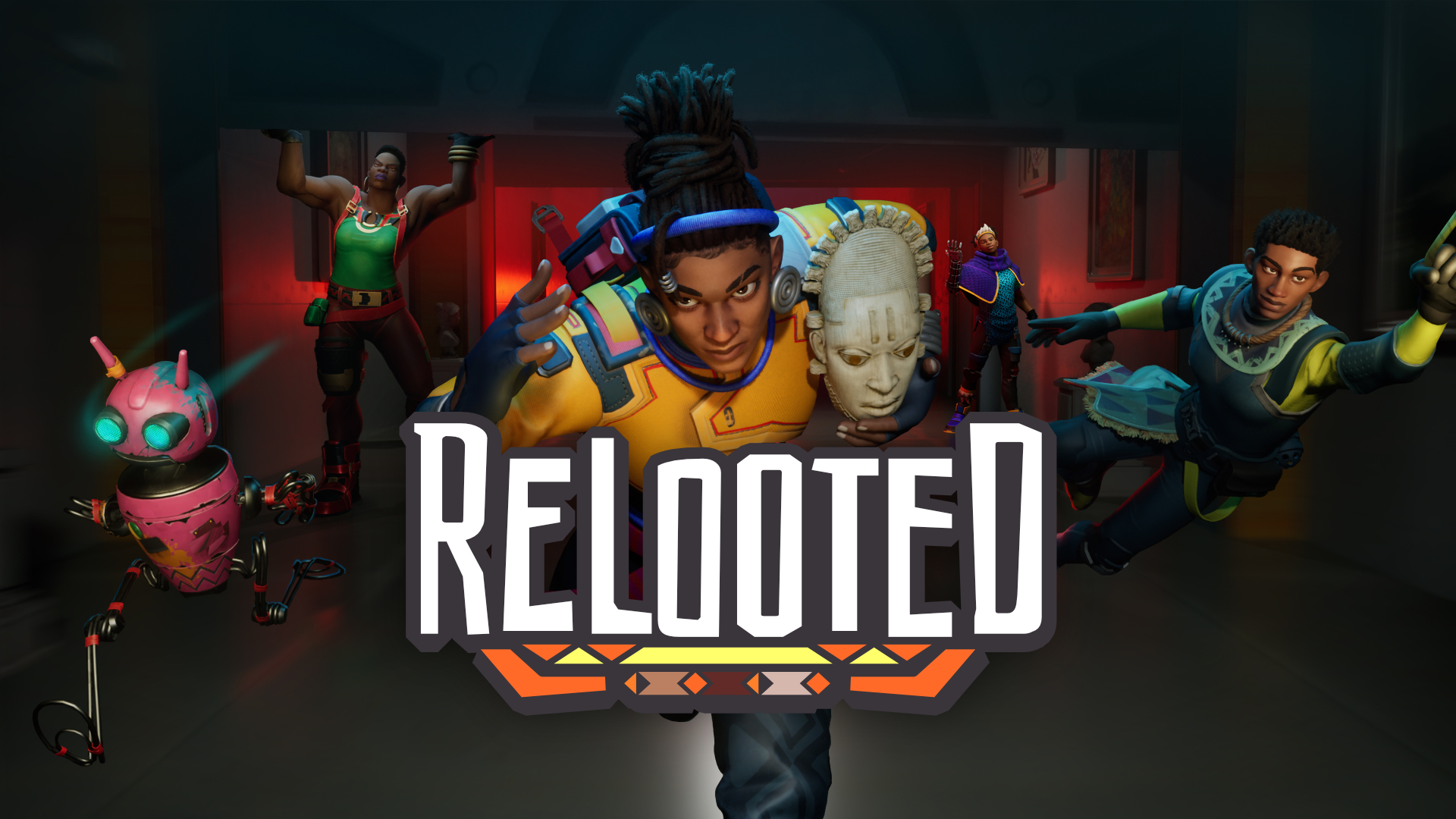
I first heard about the video game Relooted in some game showcase, I believe it was a Microsoft showcase in 2025. My interest was immediately piqued, an indie game where you retrieve stolen African artifacts back from various European museums and private collections? Hell yes, sign me up for that.
I put the game in my Steam wishlist and bought it at time of release which was on February 10, 2026. I ended spending the rest of the month playing through the game and I finished it on March 1st, 2026.
This is a heist game developed and published by a South African studio by the name of Nyamakop. This is my first time playing any video game made by this studio.
You may notice that the publication date of this review is several months removed from my having finished this video game. That was for a couple reasons – I simply did not have enough to say about the video game on its own to warrant a full review and I also thought that the subject matter of the video game deserved a deeper research dive. So I was stuck until….
Why The Brutish Museums?
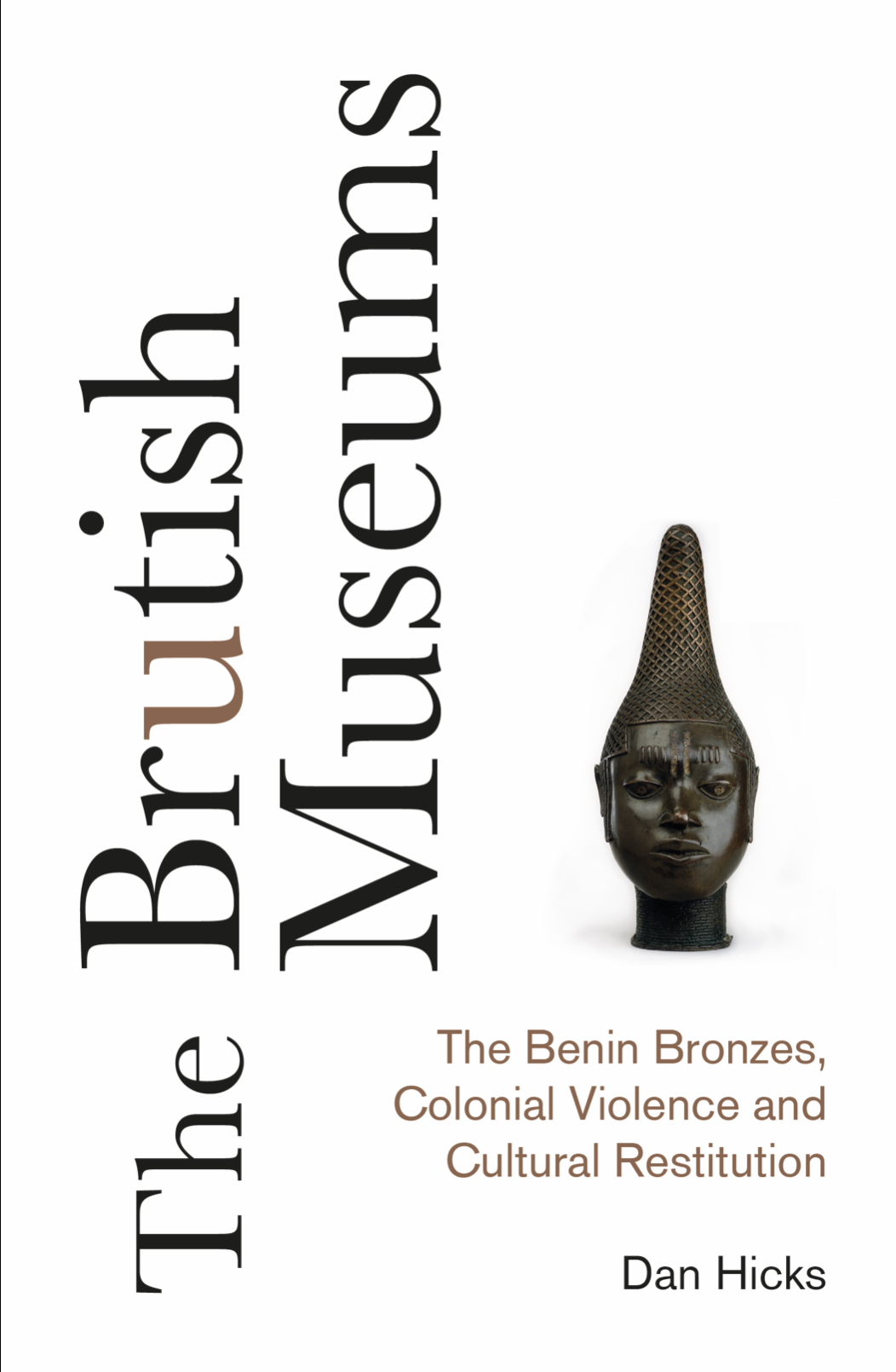
The Brutish Museums is a non-fiction book by Dan Hicks that explores the history of the Benin 1897 incident that resulted in the British colonial forces stealing large amounts of bronze artifacts from Benin, collectively called the Benin bronzes. The book explores the ideology behind the looting, and the role museums play in perpetuating colonial violence.
I first saw mention of this book while on the publisher’s (Pluto Press) website for another now forgotten reason, I saw it on a list of books on that website and thought to myself – “huh, this would be a perfect additional reading material for my review of Relooted”. Fortuitously, the book was also on sale for less than a dollar on the Kobo ebook store and I ended up buying the book on March 13, 2026.
You will notice once again that it has been several months since March 2026. Well, I just didn’t feel like reading this book for months on end and I had what seemed to be an endless parade of fantastic new debut book releases that I wanted to read instead. So here we are in May, and I am writing this after finally having read the book.
A Note About The Review Format
This will be the first time I have reviewed a video game and a book together. Hell, it has been a while since I’ve reviewed a video game on its own. So the format of this particular review is one that I will be making up as I go along. This is not strictly a review of each piece of media on its own but a synthesis of my thoughts on both the video game and the book and their relation to the topic of colonial violence and cultural restitution.
In addition to that I will add paragraph breaks to some quotes for the purposes of readability. With that bit of meta discussion out of the way, let’s get into it.
The Review
One of my earliest encounters with the concept of colonizers stealing artifacts from the people and cultures they oppress(ed) was my mom telling me about the British stealing the Koh-i-Noor diamond. The British still insist that the diamond was obtained “legally” under the terms of a treaty but let’s face it: treaties involving the colonizer and their subjects are often if not always in favour of the colonizer. It is not a treaty between equals. So let’s call it what it is – theft.
Today, the diamond is on public display in the Jewel House at the Tower of London. The governments of India, Iran, Pakistan and Afghanistan have all claimed ownership of the Koh-i-Noor, demanding its return ever since India gained independence from the British Empire in 1947.[18] The British government insists the gem was obtained legally under the terms of the Last Treaty of Lahore in 1849 and has rejected the claims.
Wikipedia contributors. (2026, June 4). Koh-i-Noor. In Wikipedia, The Free Encyclopedia. Retrieved 18:16, June 6, 2026, from https://en.wikipedia.org/w/index.php?title=Koh-i-Noor&oldid=1357745756
Museums
As regular readers of this blog may be aware, the history of colonization and colonial violence is a subject that I maintain a avid interest in. Most of my current knowledge of the topic comes from books, both fiction and non-fiction, from R.F. Kuang’s Babel exploring the relationship between colonization, language and violence to Rashid Khalidi’s The Hundred Years‘ War on Palestine which talks about the history of the still ongoing settler-colonialist project and genocide that the Israeli state is engaged in.
That brings us to both Relooted and The Brutish Museums which tackle a specific form of colonization, namely the stealing of cultural artifacts – objects of religious, historical, personal significance to the people being stolen from. While Relooted is about reclamation of these artifacts from museums, Dan Hicks’ book is about the historic specifics of the Benin Punitive Expedition and the role which museums played and continue to play in that act.
So let’s talk about museums for a bit. Dan has a lot to say about museums which is not surprising considering that he is the curator of the Pitts Rivers Museum in Oxford, England. Pitts Rivers is an archaeological and anthropological museum, more specifically in our cases, it has many objects stolen from Benin during the Benin Punitive Expedition of 1897 by British colonial forces.
Museums are devices for extending events across time: in this case extending, repeating and intensifying the violence. But endurance must also always open up a space for something new to happen because each object, each photograph, each memory, each fact, each thought or thing in the case of Benin 1897, is a live event, behind the glass of the cabinets.
Every sheet of glass holds within it the certainty of a thousand future shards. What soldiers and anthropologists and the brutish museums of Europe and America saw as relics or curios are of course forms of cultural endurance unfolding over centuries, which will outlast this wooden case, these steel mounts in which they are held, but for which colonial histories need to be not so much reversed as somehow dug into.
The Gun That Shoots Twice, The Brutish Museums by Dan Hicks
Relooted is a lot less precious and introspective about museums. In the game, museums and private collections are game levels – a fun puzzle to solve, figuring out the perfect path of traversal as you reclaim various artifacts running and jumping gaps using chandeliers and bamboozling security bots and holding open doors with tables that just happen to be lying about.
Fundamentally, Relooted does not respect the museum and why should it? Reading Dan Hicks’ commentary on the Benin Bronzes and modern anthropological museums – there is very little to respect about such museums as they are now. The contemporary anthropological museum in a former colonizer’s country is a showcase for the trophies of colonial violence.
Dan Hicks calls museums as they are now weapons.
The purpose of this book is to take stock of the use of the anthropology museum during the 1890s as a weapon, a method and a device for the ideology of white supremacy to legitimise, extend and naturalise new extremes of violence within corporate colonialism – in order to reclaim the vital function of these institutions in the future, to transform their purpose, to put an end to their function as the warehouses of disaster capitalist-colonialism: dismantle, repurpose, restitute, recognise their status as sites of conscience. The book aims to break three dominant narratives about key aspects of the sacking of Benin City.
First, to expand the story of the punitive expedition to become a wider history of colonial violence in the 19th century.
Second, to expose the truth about the supposed official nature of the looting and sale of the Benin Bronzes, and thus to trace how the sheer force with which a cultural centre was destroyed still fractures and splinters across time and space throughout the 20th century and into the 21st.
Third, to reveal the intimate links of the narrative of the so-called ‘universal museum’ with enduring processes of militarist-corporate colonialism in 21st-century global capitalism.
In each case, this is about stepping back from a focus on nation states, understanding the intertwined nature of German and British traders on the Niger River and museum curators from Berlin to Oxford, and seeing African cultural restitution today as about more than just nation-to-nation, especially where the European nation is often limited to the former colonial power: the global geographies of the Benin Bronzes holds lessons for many other cases.
The Gun That Shoots Twice, The Brutish Museums by Dan Hicks
As far as the book is concerned it achieves its three goals. I know a lot about the sacking of Benin City, I know just how white supremacist ideology played a path in justifying the sacking of Benin City. None of it was surprising to me, the patterns of colonial ideology – the dehumanization and subsequent denial of cultural legitimacy to the colonized. I have seen this over and over again, in the works of Fanon and Edward Said alike.
The Euro-American anthropology museum constitutes a further space of containment, in Fanon’s terms, of chosification in Césaire’s terms, of mummification, statuefication and fetishisation in those of Mmembe. In this transformation of life and substance museums became a key regime of practice through which Africans were dehumanised.
Here brutish museums like the Pitt Rivers where I work have compounded killings, cultural destructions and thefts with the propaganda of race science, with the normalisation of the display of human cultures in material form. An act of dehumanisation in the face of dispossession lies at the heart of the operation of the brutish museums.
Chronopolitics, The Brutish Museums by Dan Hicks
World War Zero and Militarist-Colonialism
Dan Hicks breaks down the creation of the myth of Benin 1897 in the British colonial mindset. The myth that this was just a punitive expedition, punishment for the British subjects that a local king had executed after he said he would execute the next white person to visit him. That martyr creation formed a handy pretext for what followed which is the infliction of abject terror on the locals.
It is also important to note here that Dan is talking a very specific type of colonialism, something he terms as militarist-colonialism to differentiate it from the settler-colonialism that I have read much about.
The pillaging of objects was far from just an opportunistic side effect of what the Victorians called their ‘small wars’ or little wars’ of colonial expansion in Africa. Loot and pillage were of central importance to extractive and militarist colonialism, just as land was to settler colonialism, but dominance of settler colonialism as a model for anglophone academic discourse in and about European imperialism has narrowed our conception of dispossession and its place in the ideology of race, in stark contrast with the genealogies of Raubkunst – the act of taking supposedly degenerate art from those who are defined as inferior – traced by Aimé Césaire, Sven Lindqvist and others from Africa in the 1890s to the soils of Europe in the 1930s.
A Theory of Taking, The Brutish Museums by Dan Hicks
The book spends quite a bit of page time on the specific weapons the British used, the Maxim heavy machine gun in particular.
Benin was presented as ‘degenerate’. And the exhibition of degenerate art, and the industrial slaughter of its people, defined as inferior, and the demolition of its religious and cultural sites, was a forewarning of the horrors of the 20th century. Here the ethnological museum must take its place alongside the fortified trench, barbed wire, the Maxim machine gun, and the tank, as part of the coming techno-brutality of the 20th century.
Chronopolitics, The Brutish Museums by Dan Hicks
The Maxim gun is a recoil-operated machine gun invented in 1884 by Hiram Stevens Maxim. It was the first fully automatic machine gun in the world.[1]
The Maxim gun has been called “the weapon most associated with imperial conquest” by historian Martin Gilbert,[2] and was heavily used by colonial powers during the “Scramble for Africa“. Afterwards, Maxim guns also saw extensive usage by different armies during the Russo-Japanese War, the First and Second World Wars, as well as in contemporary conflicts.
Wikipedia contributors. (2026, May 21). Maxim gun. In Wikipedia, The Free Encyclopedia. Retrieved 19:04, June 6, 2026, from https://en.wikipedia.org/w/index.php?title=Maxim_gun&oldid=1355412998
Dan terms this particular kind of tech-brutality “World War Zero”, a precursor to the horrors of trench warfare during WWI, the people of Benin serving as field testing for the then newly created fully automatic machine gun. British forces massacred large amounts of people and burned entire villages down during Benin 1897 in what Dan terms as a democide.
The Revenge Fantasy
Relooted is not particularly interested in directly exploring the violence required to obtain these artifacts. To be fair, it never tells you that’s what it is going to give you. I got exactly what I wanted and needed – a fun heist game where I get to reclaim artifacts from musuems and private collections across the world. The game doesn’t limit itself to the reclamation of African artifacts, there are Indian and Haitian artifacts in there. In fact, the aforementioned Koh-i-Noor diamond is something you reclaim during the course of one of the levels of the game.
The game itself wants you to have a fun time playing it and I did in fact have a marvelous time. I loved the majority cast of Black characters with the playable character being Nomali. The game also takes great care in actually talking about what these artifacts actually are, which people they were stolen from and their cultural significance – it does this using the pre-mission briefing cutscene. There is also handy glossary section of your home base where you can look at read more about the artifact.
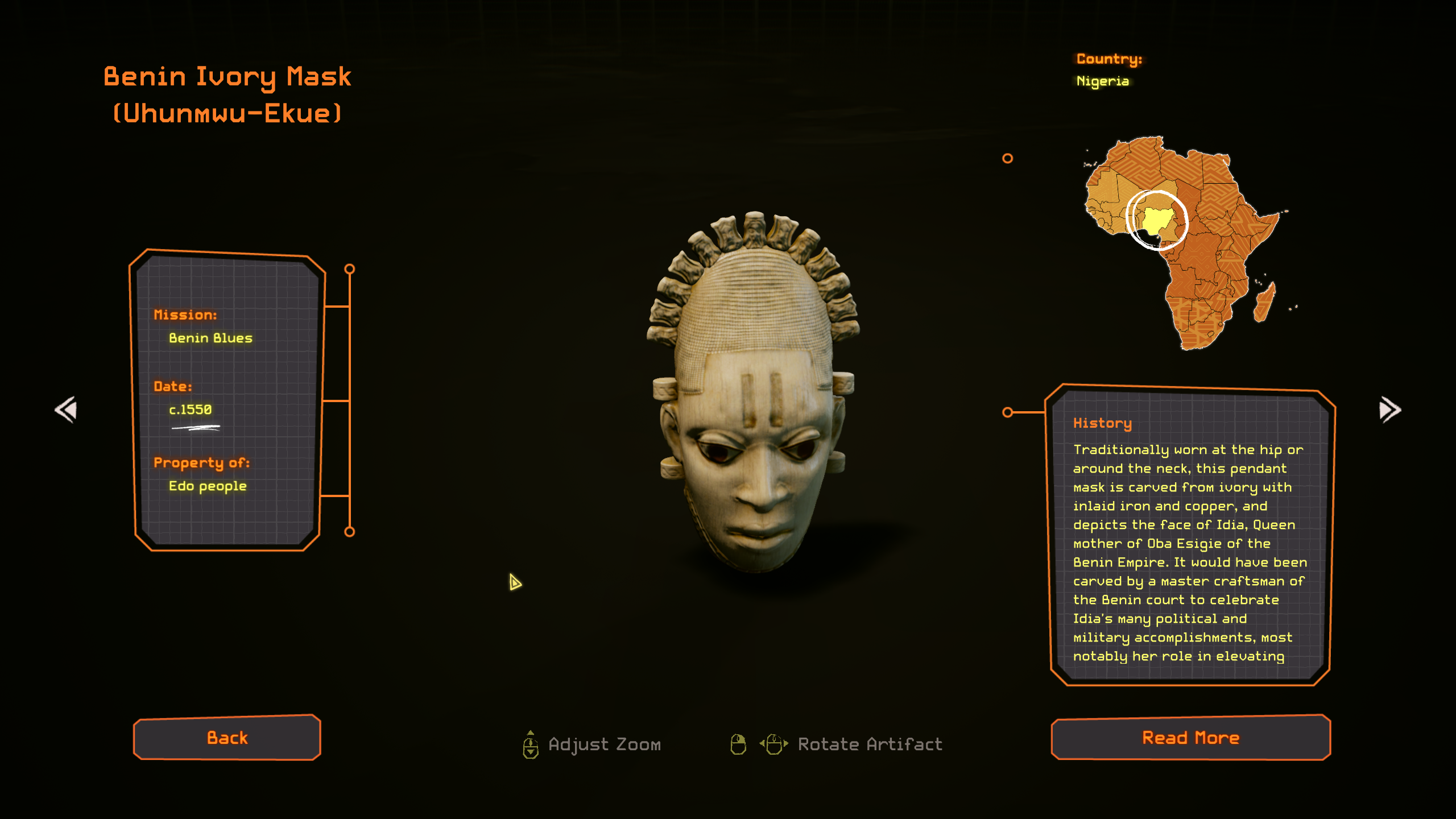
I very much like that Relooted took the time to go more in-depth with these explanations, understanding the history and cultural significance of these artifacts made playing this game both an educational and fun experience. Both the book and the video game were educational in different ways. Like with the myth of the “punitive” Benin expedition, the video game offers a different revenge fantasy, something more morally justifiable and with a much lower body count. I appreciated the catharsis I got from playing the game.
It’s Always Capitalism
The ecology of the ultraviolence of World War Zero, 1884-1914, was driven principally by the re-introduction of a dangerous new element to the famous ‘three Cs’ of Thomas Buxton and David Livingstone. As Philip Stern has put it: to the Holy Trinity of commerce, Christianity, civilisation, was added a fourth: the corporation.
World War Zero, The Brutish Museums by Dan Hicks
The importance of capitalist ideology within the colonial mindset cannot be understated. That remains the case in Benin 1897 as it did for European colonial exploits elsewhere. The machines of capital love colonial conquest because it means new heretofore resources to extract and labour to exploit.
Dan goes into great details of the specific commercial interests in Benin and the surrounding regions of Africa. I confess to skimming through most of these as the minutiae are not as important to me as the fact that at the end of the day, the racists are also greedy and they are here to make themselves and their friends a lot of money.
On War on Terror
In these wars on supposed terror, a kind of temporal violence was enacted in the form of reciprocity. What I mean by this is that just as the theory of ‘militarist colonialism’ in practice justified theft as a kind of repayment, so the same mental process took place in the justification of war. In both cases, the operation involved a shuffling in time frames.
African retaliations to violence were presented as having been premeditated for years in advance, while long-planned British attacks were claimed as purely reactive – against slave-raiding in Company territories to the north, and against human sacrifice in Protectorate territories to the south.
These temporal projections – part time-warp, part head-trip – marked the ideology of militarist colonialism and signalled the beginning of militarist humanitarianism: the use of a ‘human rightist’ justification for unprovoked regime change.
War on Terror, The Brutish Museums by Dan Hicks
Dan connects the ideology of militarist-colonialism to contemporary militarist humanitarianism and justification for unprovoked regime change which is not something I was expecting so I am noting it here. Logically, I follow the connection but I don’t have any further comment on it.
Achille Mbembe: Necropolitics
The Brutish Museums brings to bear the concept of necropolitics as defined by Cameroonian historian and political theorist Achille Mbembe in its analysis of the events of Benin 1897. Namely, it uses the term “necrography” as well.
Necropolitics is a sociopolitical theory of the use of social and political power to dictate how some people may live and how some must die. The deployment of necropolitics creates what Achille Mbembe calls deathworlds, or “new and unique forms of social existence in which vast populations are subjected to living conditions that confer upon them the status of the living dead.”[1] Mbembe, author of On the Postcolony, was the first scholar to explore the term in depth in his 2003 article,[2] and later, his 2019 book of the same name.[1] Mbembe identifies racism as a prime driver of necropolitics, stating that racialized people’s lives are systemically cheapened and habituated to loss.[1]
Wikipedia contributors. (2026, May 16). Achille Mbembe. In Wikipedia, The Free Encyclopedia. Retrieved 13:41, June 7, 2026, from https://en.wikipedia.org/w/index.php?title=Achille_Mbembe&oldid=1354425782
Dan Hicks asserts that the necropolitical conditions created in Benin were done both through physical violence brought upon by the Maxim machine guns and also the looting of cultural artifacts that followed.
in Mbembe’s view, it is the use of the bulldozer for the continual destruction of the lived environment, as much as the fighter jet used for precision strikes targeting individuals, that are central to the practice of neocolonialism in Palestine – an ‘infrastructural warfare’: ‘We learn from Mbembe that necropolitical conditions can be made through attacks upon the nonhuman environment as well as just the human body.’
Necrography, The Brutish Museums by Dan Hicks
This was my first time encountering the concept of necropolitics so I would like to thank the book for introducing me to this topic. I don’t have any further commentary on it but I wanted to note it here because I found it interesting.
Restitution
Restitution is not subtraction; it is refusing any longer to defend the indefensible; it is supporting African institutions, colleagues and communities; addressing western museums’ roles as sites of conscience and remembrance, tackling the ongoing effects of racial violence, paying a debt, rebuilding a relationship. No museum can stop the world from changing around it.
Ten Thousand Unfinished Events, The Brutish Museums by Dan Hicks
Restitution is at the heart of both The Brutish Museums and Relooted and that is indeed the topic that made me write this particular review in the first place. Throughout the book Dan Hicks makes the case for restitution and why it is indeed necessary. Like with the colonial myth of Benin 1897, restitution is also wrapped in myths about “subtraction” as Dan puts it.
Relooted on the other hand is tired of the formal processes of restitution and repatriation. The game begins by one of the characters saying that she had tried the formal route and had not succeeded. The museums had opted to hide their artifacts instead of returning them to their places of origin. And so forms the core premise of the game – the failures of formal processes leading to the direct action of restitution.
Relooted is quite literally about how direct action gets the goods. The characters of the game are well aware of the various risks involved in carrying out these heists but they do not question the morality of such actions, it is assumed to be a good thing they are doing and worth the risk they are taking.
The Brutish Museums makes the case for restitution using a historical analytical lens, Relooted doesn’t see the need to make any such case. It assumes you are already on board, “hey do you want to reloot some artifacts from historical museums?” is a question that it assumes you are going to say yes to. It is a refreshing and fun take on decolonization. I wish I played it alongside my reading of the book as it would have served as a welcome palate cleanser from the rather dry text of the book.
Concluding Thoughts
Relooted is the most interesting game I have played this year so far, at least from a thematic perspective. The gameplay, character designs, and world while good were not remarkable, the voice acting felt a little awkward in places but it seemed to have been delivered with a great deal of heart so I can forgive that.
Most importantly, Relooted served as a jumping point for me to learning more about the colonial violence that led to these artifacts ending up in American/European museums and private collections. Reading The Brutish Museums was a rather dry reading experience but it was about what I expected from it. It is the kind of non-fiction I would only read if I was very curious about a topic and needed to read it for research purposes.
I thank both the video game and the book for the education they both provided on a topic I had basically no familiarity with. I don’t imagine I will be making this kind of dual review a regular occurrence on this blog but it is a useful if unwieldy format for connecting two related but very different pieces of media together.
All that said, I am looking forward to reading lighter fare for my next book. I could definitely use a palate cleanser. That’s all from me, see y’all in the next one.
Thank you for reading this blog post. Please consider supporting my writing work through Patreon. Additionally, please share this post on your socials and/or with your friends. It really helps! If you have any thoughts/feedback/thoughtful criticism to share, feel free to use the handy contact me page to send that to me.