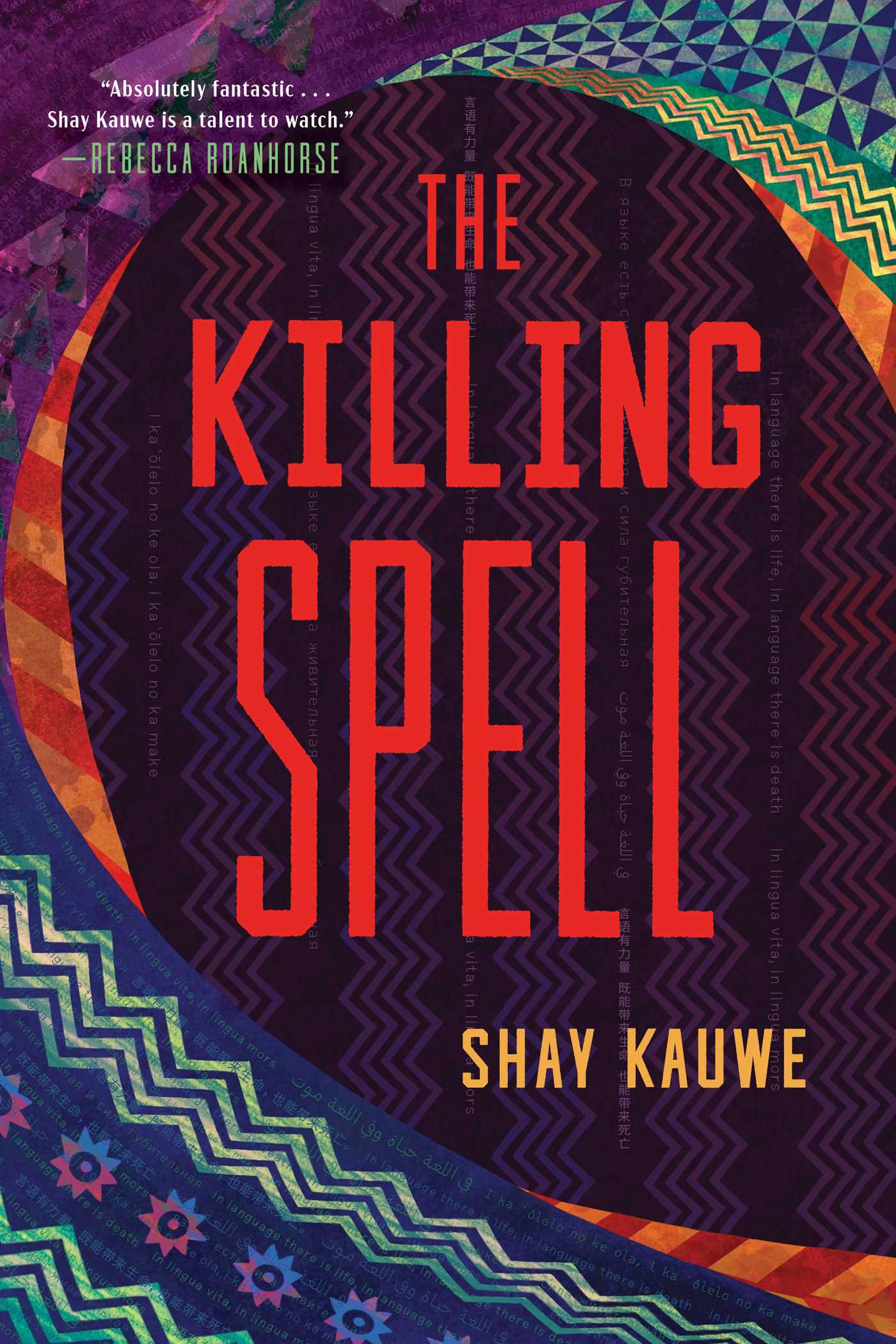
In language there is life; in language there is death.
page 36
Table of Contents
Why The Killing Spell?
I first saw The Killing Spell on a Kobo new releases email back when it came out in April 2026. It is a debut fantasy novel and more notably I found out from reading the author’s website that this was the first traditionally published adult fantasy novel by a Hawaiian author.
In addition to it being a debut fantasy novel, it is also a urban fantasy novel and that is a fantasy sub-genre I am very much interested in. It feels like we don’t get much new there so a debut urban fantasy is very welcome. I placed a hold for it in April but due to the delays in the hold system in combination with me putting a pause on the hold in mid-May I didn’t get to this book until the beginning of June.
This is my first time reading anything by Shay Kauwe and I read a paperback edition published in April 2026 by S&S/Saga Press. Author blurbs on this edition – Rebecca Roanhorse, Aleese Lin, Chris McKinney, Manuia Heinrich.
Without further ado, let’s get into it.
The Book
The Killing Spell is a urban fantasy novel set in what appears to be contemporary or near-future Los Angeles. It is not clear when exactly this book happens because the book never mentions a year but from context clues it appears to be either contemporary or near future. This is a city-state version of Los Angeles after an apocalyptic incident known only as The Flood.
The book never explains what exactly the Flood is but whatever it is led to the US federal government falling apart and large cities like Los Angeles becoming city-states ruled over by members of magical families on a Board of Casters. Magic in this world is heavily regulated, any prospective Guild members of any vocation namely Caster and Smith must pass a licensing examination in order to practice magic within Los Angeles.
Magic System & Language
Where this magic system becomes very interesting is that it is entirely based upon the use of languages. The regulated languages for magic are – Latin, French, Italian, Spanish, Arabic, Cantonese, Mandarin, and Japanese. Arabic, Cantonese, Mandarin, and Japanese being newly added by the Board. Regulating a language means power as a licensed member of one of these language magic users gets to be on the Board.
The important thing to note about Hawaiian is that it is primarily a spoken language and not a written one and writing spells down in Hawaiian means that they lose their mana and become ineffective so spells are passed down generation to generation verbally. There is also the family spell known as Mana o ka moʻokūʻauhau which is unique to each family and never shared outside of a clan. Kea has not come up with a new family spell and as such she isn’t on the Homestead council.
Throughout out the book we see magic performed in other languages – Japanese, Cantonese, Arabic, Latin, and English. Each language has magical specializations, characteristics that make them particularly good at certain forms of magic. Spanish for example is really good for curses. Japanese for healing and so on.
The magic system also includes so-called sympaths, people who have an innate ability to perform magic without casting. Kea’s sympath ability is to be able to detect the mana/magic of other magic users. Sora is able to poke into someone’s mind and see if they are telling the truth. The abilities are always linked in some way to what the person is named, Sora as in the Japanese word for sky and so open skies = truth.
This is by far the most interesting way I have seen language and linguistics being made part of a magic system. I think this book does a better job of exploring the possibilities of such a magic system compared to The Poet Empress which also makes use of language based magic.
Characters & Plot
That brings us to the main character of The Killing Spell – Kea aka Kealaokaleo Petrova, 25, and a Hawaiian magic user living on The Homestead, an area on the outskirts of Los Angeles out of the Board’s direct control and in which the Hawaiian population live. Kea is the head of the Petrova clan, and a unlicensed Smith who makes and sells spells in Hawaiian. As such, she is on the margins both in the Homestead where her clan is not on the council and the larger world of Los Angeles where she is essentially a criminal.
The book is all from Kea’s perspective and a lot of it involves her interactions with Sora Kaiser as they investigate the mystery. I loved the interactions between Kea and Sora. Sora is the silent, brooding type who’s got a heart of gold under that exterior. Sora is all business. Kea is the practical, protect the Homestead and my family at all cost type, they butt heads often and Sora finds himself exasperated with Kea often. I liked this dynamic.
The plot of The Killing Spell is at its core a murder mystery. Kea is tasked with solving the murder of one Angelo Reyes, a prominent Filipino activist who is found murdered by a death spell that can only exist in Hawaiian. Angelo was also the primary champion of getting Tagalog added to the list of regulated languages.
To make matters worse, the murder happened in Griffith Hall aka the Board’s headquarters which implicates someone on the Board and/or someone close to them. So every member of the board including Kea’s partner in investigation Sora Kaiser. It is quite the ride from start to finish. The book maintains a brisk pace throughout and there is no wasted time.
I also loved the romance sub-plot between Kea and Sora, I thought it was cute. I thought there was good chemistry between the two and I appreciated how the romance was developed throughout the book. It develops at a fairly fast pace alongside the rest of the book but it didn’t feel rushed or underdeveloped to me.
Themes
The primary theme at the beating heart of The Killing Spell is resistance and more specifically the use of language as resistance. The Hawaiian language is currently still considered critically endangered due in part to active suppression by colonial powers for nearly a 100 years.
In 1896, the Republic of Hawaii passed Act 57, an English-only law which subsequently banned Hawaiian language as the medium of instruction in publicly funded schools and promoted strict physical punishment for children caught speaking the Hawaiian language in schools. The Hawaiian language was not again allowed to be used as a medium of instruction in Hawaii’s public schools until 1987, a span of 91 years.[9] The number of native speakers of Hawaiian gradually decreased during the period from the 1830s to the 1950s. English essentially displaced Hawaiian on six of seven inhabited islands. In 2001, native speakers of Hawaiian amounted to less than 0.1% of the statewide population.
Wikipedia contributors. (2026, June 9). Hawaiian language. In Wikipedia, The Free Encyclopedia. Retrieved 13:47, June 10, 2026, from https://en.wikipedia.org/w/index.php?title=Hawaiian_language&oldid=1358486260
Throughout the book Kea defiantly continues to use Hawaiian as her magical language and the book very much centers Hawaiian culture. This is the first time I have read a fantasy novel that has both a Hawaiian main character and also makes the Hawaiian language and culture a core part of its worldbuilding. I very much enjoyed this and I want to see more books like this written by Hawaiian authors and traditionally published.
Along with the theme of resistance is the related theme of colonization, in this case by the city-state of Los Angeles which wants to annex the Homestead either by wiping out all the Hawaiians or buying the land from them. Some members of the Board also see the Hawaiian language as fundamentally inferior to the currently regulated languages, another echo of the historical suppression of the Hawaiian language.
Concluding Thoughts
I greatly enjoyed my time reading The Killing Spell. The language based magic system was well crafted and perfectly intertwined with the book’s primary theme of using language as a form of resistance. I liked Kea as a character and her romance with Sora was cute. The murder mystery itself was fine but the highlight really was the use of Hawaiian culture in the book’s worldbuilding, a world that I want to see more of.
This is a fantastic debut and I look forward to reading more from Shay Kauwe. I definitely would love to read more in this book’s world and a series involving Kea and Sora becoming a investigative power couple sounds really fun. Moreover I really really want to see this magic system explored more over the course of a series because there is a lot of potential here!
One last thing – this is another debut novel that doesn’t appear to have gotten a hardcover edition. Like with previous such debut novels, I would like to call out the published S&S/Saga Press for this. I think this book deserves a hardcover edition especially with the lovely front cover design it has.
That’s all from me, see y’all in the next one.
Thank you for reading this blog post. Please consider supporting my writing work through Patreon. Additionally, please share this post on your socials and/or with your friends. It really helps! If you have any thoughts/feedback/thoughtful criticism to share, feel free to use the handy contact me page to send that to me.