Nupol wasn’t a language, not really. It was an argot. A cant. A cryptolect. Although it was loosely based on Inglez, the one language that most people in most berths were familiar with, its vocabulary come from everywhere. Dead Earth languages and multilingual puns. Backslang and gender reversal. Vera, after a certain point you stopped learning it and started cooking it up. It wasn’t language, it was music. Improvisation. The prattle of the disenfranchised, the palaver of the dispossessed, the lingua of the underground. And, like all underground languages, it was made to be disguised.
Chapter Two: Damietta, 23 of 25
Table of Contents
Why The Republic of Memory?
I first heard about The Republic of Memory from cari can read’s video about anticipated fantasy and science fiction books of 2026 in February. The book compared itself to A Memory Called Empire and Children of Time – both scifi books I liked and enjoyed so my interest was immediately piqued.
What got me to put in a ebook preorder for the book was that it is described itself as being set in an Arabfuturist world. Arabfuturism is not a term I had seen before this and I was very intrigued by it. In addition to that, this is also debut science fiction novel. The book released on the 5th of May, 2026 and I started reading it on 16th of May, 2026.
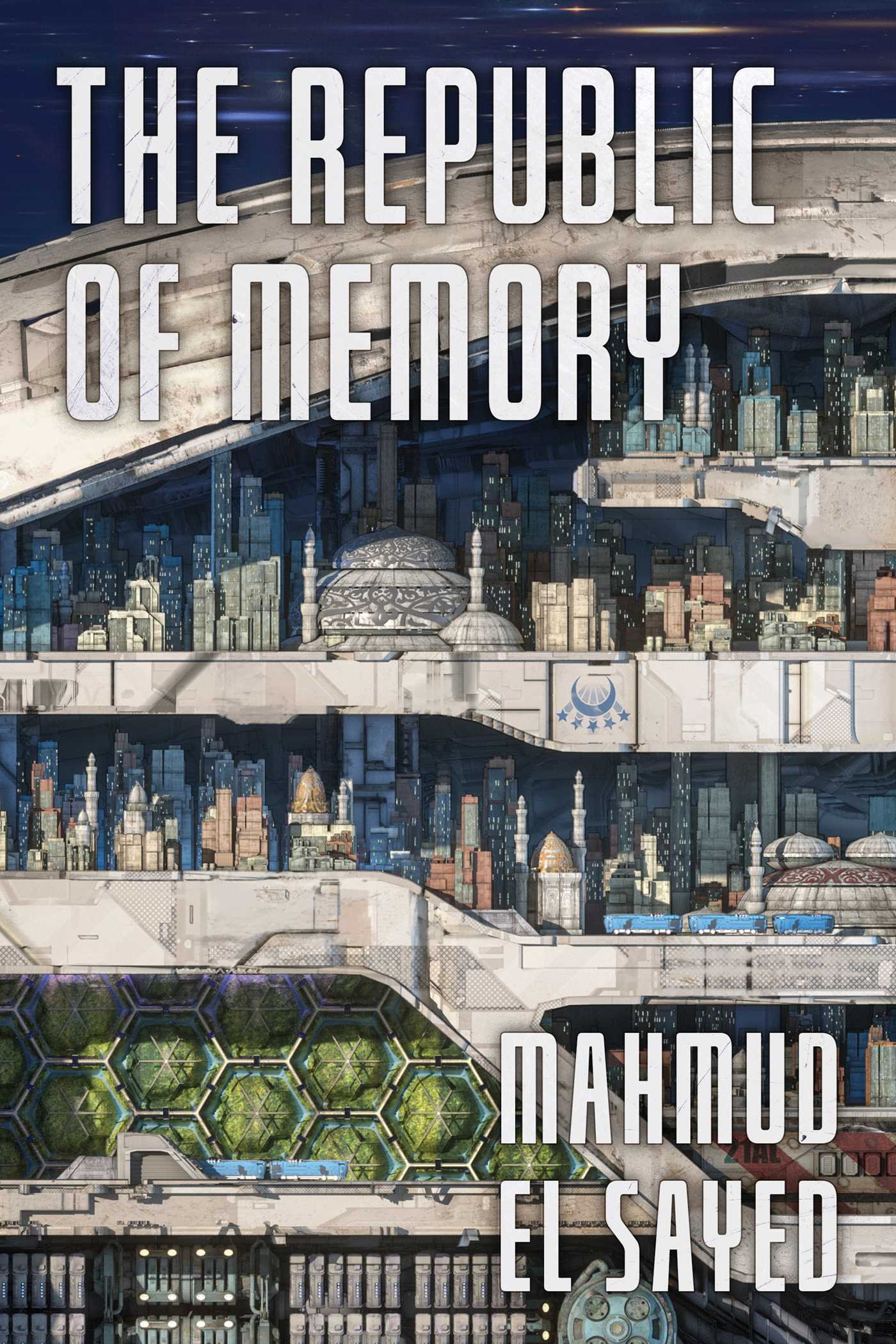
The ebook edition I read (ISBN/UID: 9781668207215) had author blurbs from Sam J. Miller, Bethany Jacobs, Nicholas Binge, and Gautam Bhatia. Another notable thing about this book is that it was published in the UK by a different publisher – Gallancz, an imprint of Orion. That particular edition in addition to getting a hardcover also has a different (and much worse) cover design.
Let’s get into it.
The Book
The Republic of Memory is a debut science fiction novel set on the generation ship Safina which is halfway through its four hundred year voyage from the ruins of Earth to create a colony on a planet called Hurriya. The crew of the ship maintain the ship and one of the most important responsibilities they have is maintaining the cryostasis chambers of their sleeping ancestors.
Language
In addition to the ship being divided into various geographical locations referred to as berths, the ship’s population is also divided according to the primary language they speak. Right off the bat, The Republic of Memory makes it clear that this is a book about language and linguistics. I see where the A Memory Called Empire comparison comes from.
In the early days of the Safina‘s voyage the First Crew had thrown off the shackles of the old Network Empire and agreed to the Compact, dividing the ship according to language. Translators–speaking a language that was native to none of them–served as the bridge between the rarefied heights of Administration and the rest of the crew. If you wanted to register anything, from a new work assignment to a birth permit, then you needed to deal with Admin. And if you wanted to deal with Admin, then you needed a translator to do it on your behalf.
Chapter One: Iskandar, page 19 of 26.
I’ll also note here that according to the author’s bio on the publisher’s website, they are a translator and also have an interest in linguistics. That very much shows throughout the book.
Mahmud El Sayed is a British Egyptian science fiction and fantasy writer and translator. A former journalist, he won the 2023 Future Worlds Prize for Fantasy and Science Fiction Writers of Color for his work focusing on Arabic and Islamic–inspired themes in a genre he is calling Arabfuturism. He lives in East London where he spends his time pondering linguistic oddities and running story ideas by his cat.
About the Author, Simon & Schuster
Languages spoken on the ship include Arabek (an Arabic diglossia), Inglez (English), Nihono (Japanese), Russo (Russian), and Nupol. Translators like Iskandar (one of the main characters) have to be fluent in Inglez as that is the language used by Administration. Of these languages, Nupol is the most interesting of them, the quote at the beginning of this review explains what it is. Large chunks of the book involve characters talking/thinking in Nupol.
Things are bona as a stroll through a gardino, my old mucker. Everything is benny as oro and twice as bright.
an example of Nupol, Chapter Chet: Billy
The Republic of Memory makes liberal use of this Nupol cant and at first it was a little difficult to understand what the characters were saying but as I read more of it I started to make sense of it. It is not particularly difficult because of it being based on English with other Earth languages mixed in. I ended up enjoying this aspect of the book, it made me feel more immersed in its world and connected to its characters.
Characters & Revolution
That brings us to the key theme of The Republic of Memory which is revolution. A revolution is made up of people and in the case of the book it is made up of characters. The book starts off with two different perspectives – Iskander Ezz, translator, a reformist who works within the system and wants to change it from the inside and Damietta Ezz, Iskander’s younger sister who is more radical and is part of the Haraka, a revolutionary group on the ship.
Iskander is the perfect portrayal of a reformist, to the point that I found him at times to be milquetoast and boring. Damietta on the other hand is an almost perfect characterization of what a young revolutionary can be. Rebellious, wide-eyed optimism and a revolutionary zeal that is not yet tempered by time. I found her a little bit annoying in the beginning but as the story progressed I started to warm up to her.
As is the case with real life, revolutions are not made up of just two people and as the book progressed into the second half and as the powder keg of revolt on the ship was about to blow up more characters were introduced. In total, by the end there are twelve distinct character perspectives, with some getting more time than others.
I have previously commented on how a large number of character perspectives can cause problems for a book but it works out in The Republic of Memory. It helps that every character introduced adds something to the revolutionary mix that is being brewed throughout the story, so even if a character gets just one or two chapters their contribution provides some additional bit of context that makes the world feel more grounded.
I felt that while the book wanted to emphasize that a revolution is a mass movement of people and the individuals involved in any and all capacities are important, it also showed that the revolution itself becomes an entity of its own – in a sense the people committing revolutionary actions are then motivated by the entity that those actions create and occasionally people get swept up by it like they would be by a wave pool.
I also liked how the book tied its linguistic explorations with its theme of revolution. The creation and use of Nupol – a language used by the revolutionaries in this book really gives the sense that the author thought deeply about how languages can be a part of a nascent revolutionary movement.
Conclusions
I had a fairly good time with The Republic of Memory. It had an interesting world with a thoughtful exploration of the nature of language and revolution set in a Arabfuturist world with actual representation of various Arab cultures in the form of language, food, and religion with a diverse cast of characters.
This book is the first in The Song of the Safina duology – according to the note at the end of the book the second book is coming out in 2027. I very much want to see where this story goes so I’ll be reading the second book when it comes out. As far as Arabfuturism is concerned, I am on board, I would love for other Arab authors to write books in this sub-genre.
That is all from me, see y’all in the next one.
Thank you for reading this blog post. Please consider supporting my writing work through Patreon. Additionally, please share this post on your socials and/or with your friends. It really helps! If you have any thoughts/feedback/thoughtful criticism to share, feel free to use the handy contact me page to send that to me.