I felt it sometimes when biting into a slice of garden-grown cucumber marinated in balsamic or diving into the ever-cool waters of the spring, how the state mounted a threat to our joy, how the state seemed increasingly to want to destroy it, and how we, therefore, guarded the joy more steadfastly.
page 6
Table of Contents
Why Mad Eden?
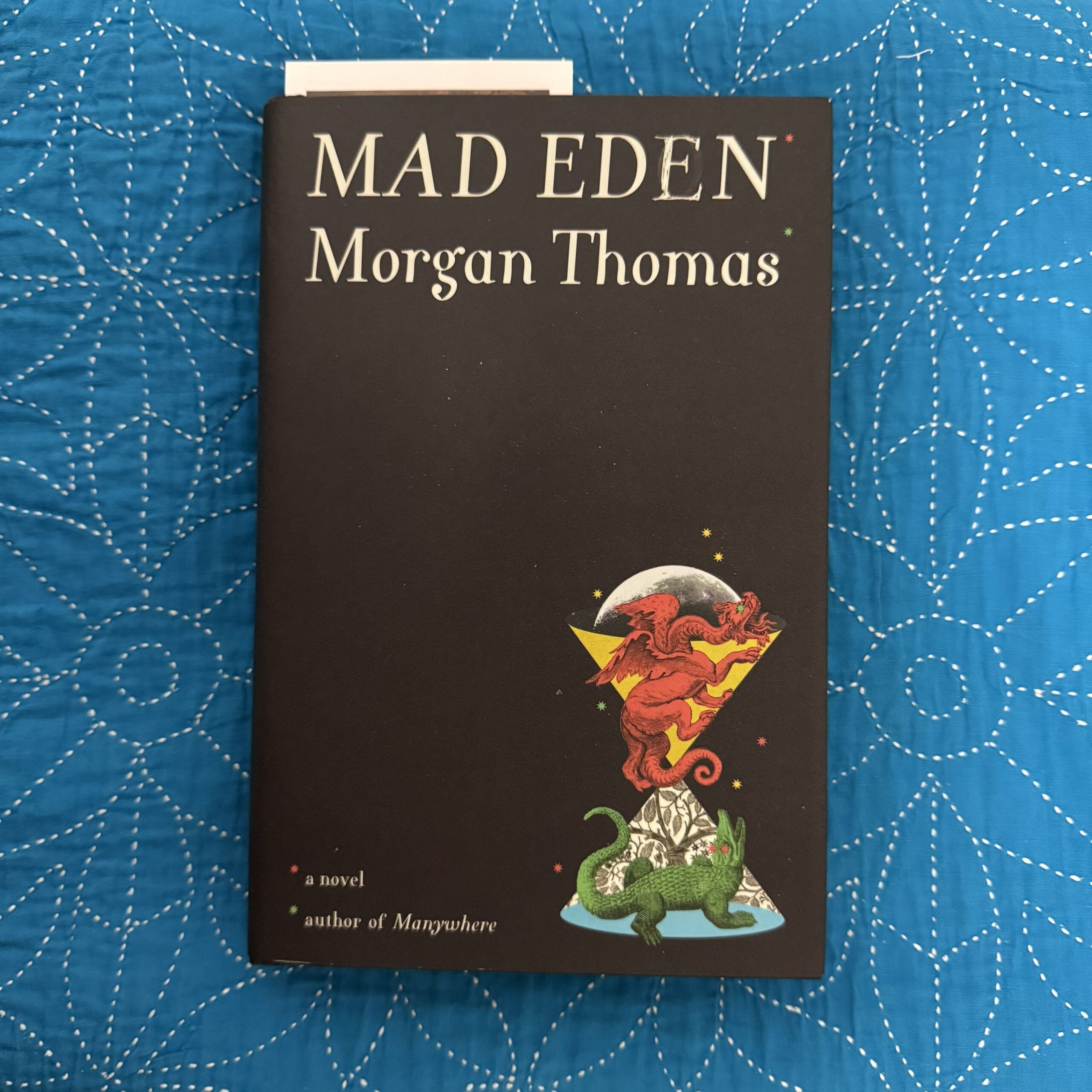
I first heard about Mad Eden through a bookshop.org newsletter shortly at the time of its release in June 2026. I thought that the premise sounded intriguing and it had multiple axis of representation I was interested in – character(s) on the autism spectrum, and also trans masculine characters. The latter of which is quite rare in contemporary fiction in my experience.
I ended up buying a copy of the book from Book City shortly after its release and it has been sitting on my desk unread since then. The subject matter of the book seemed challenging and quite possibly depressing and I wasn’t in the mood to read more of that kind of material in June…or most of July. So it was not until the very end of July that I read this book.
I read a hardcover edition of the book (ISBN/UID: 9780374620158) published by MCD in June 2026. This is my first time reading anything by Morgan Thomas. Author blurbs on this edition of the book are from – Morgan Talty, Charlie Jane Anders, Emma Copley Eisenberg, ‘Pemi Aguda, and Daphne Palasi Andreades.
Let’s get into it.
The Book
Mad Eden is a contemporary literary fiction novel that tells the story Ro and his partner Liam who live in a ramshackle cabin in rural Florida. Ro is a patient navigator for people seeking gender-affirming care and Liam is a freelance translator. They are to put it simply, working poor and as such always in a precarious position financially due to the nature of both of their jobs.
Ro has been newly diagnosed with autism and their autism spectrum behaviours present in the book with things like echolalia, a strong desire for routine, a complicated relationship with physical intimacy, periods of going non-verbal, and a tendency to hyper-fixate on specific things for long periods of time. Liam, I couldn’t quite get a handle on, he obviously seems to care about Ro and other people in his life but is also on edge with the way Ro behaves sometimes.
Mad Eden has a lot going on in its fairly short length but at its core it is about two things. Firstly, it is a meditation on joy and how Ro and Liam are able to find and preserve joy in their precarious lives. The second is an extended metaphor for the perception of time through Ro’s hyper-fixation on a online serial story by the titular name Mad Eden.
The immediate thing that struck me about the book is its writing style. It is told (mostly) from Ro’s perspective and his perspective is very stream-of-consciousness in its flow. Hyper-fixating on one particular topic, going into rabbit holes. Echolalia. All of these are presented in long paragraphs. It was mildly disconcerting to read as it felt eerily similar to how I think sometimes. I think it is a fairly accurate textual representation of how (some) people on the autism spectrum think.
The description for Mad Eden describes it as “deliciously destabilizing” and I think that is a very accurate description of the feeling I got when read this book. The writing style also perfectly matched the story at play with Ro and Liam as a series of events start destabilize their precarious existence. The writing style was appropriate for the kind of story the book was trying to tell.
To be quite honest, I wasn’t playing too close attention to the intricacies of the the story inside the story (aka the web serial). I understand that parts of it are vital to Ro’s perception of the world and using characters of the world itself as analogues for people in Ro’s life. However, the metafiction itself was not interesting to me – the rest of the story was.
This is not the first time I have read a metafiction novel, one of my 2025 books of the year was the wonderful Death of the Author which featured an entire science fiction metafiction aspect to it that I very much enjoyed. I’ll give Mad Eden‘s attempt at metafiction this; it felt very thematically connected to the rest of the story, and more specifically about people on the autism spectrum and their perceptions of time, routine, and sexuality.
Time and Memory
Other people, maybe, have memories arranged like coat hangers along time’s linear axis, marching left to right, all of them neatly in the past tense or—if you select one—shifting obediently to the past perfect to mark the divide between past (selected, remembered, continuous) and past past. My memories are mostly bucketed. A bucket for stress. A bucket for shame. Some would pathologize this.
page 7
I found the way Mad Eden talked about autistic perception of time and memory to be quite intriguing. For example, the above quote about memories being bucketed instead of being a linear axis of events is one that I can (mostly) relate to. I also put my memories into various nebulous buckets that shift as I move through life. There is the bucket for my teenage years, my bucket for my university years, the larger buckets for my twenties. Separated even further into good and bad memories etc. etc.
In a paper called The Experience of Time and Its Disorders, Thomas Fuchs postulates that manic and depressive symptoms could be caused by abnormal acceleration or retardation of one’s experience of time, a desynchronization of personal time from consensus time.
page 61
This was also intriguing. I don’t know enough about psychology to comment on the scientific validity of such a theory. However as someone who has experienced both manic and depressive symptoms in my life, I can say that in the case of mania, the so-called desynchronization of personal from consensus was something I felt acutely. It was not just a matter of temporality as the paper calls it, but it felt like I was out of sync with consensus reality as a result of manic acceleration.
Trans Representation
Mad Eden is also very much a book that tells a story about the complexities of trans existence in the United States – accessing gender-affirming care, patient navigators, the financial burdens of accessing such care, the continuous and unrelenting of a state and society hostile to the existence of trans people; all of this presented with a good amount of nuance and care throughout the story.
Intertwined with all that is the story of Quentin, a trans masc teenager who Ro and Liam become quasi-parents for and who visits them on their way to college where they are planning to start T. I found this to be one of the most heartwarming parts of the book – Ro and Liam struggle to figure out what to do and how to help Quentin navigate this very stressful time in his life while managing their own set of issues. Family is complicated and that applies to found families too.
Concluding Thoughts
Mad Eden was an intriguing, yet challenging read. The stream-of-consciousness style of writing made the reading experience a bit challenging as Ro’s thoughts moved in and out of digressions and hyper-fixations and into “present” time. That said, it wasn’t anything insurmountable and the positives of the book – nuanced autism spectrum and trans representation, usage of a rather novel extended metaphor for autistic perceptions of time, complex characterization – all more than made up for it.
This is Morgan Thomas’ debut novel and it continues the trend of me reading some very good debut novels this year. I am glad I took a chance on this novel. I would definitely like to read more of Morgan’s work in the future.
That’s all from me, see y’all in the next one.
Thank you for reading this blog post. Please consider supporting my writing work through Patreon. Additionally, please share this post on your socials and/or with your friends. It really helps! If you have any thoughts/feedback/thoughtful criticism to share, feel free to use the handy contact me page to send that to me.