The sound of the Gion Shoja bells echoes the impermanence of all things; the colour of the sala flowers reveals the truth that the prosperous must decline. The proud do not endure, they are like a dream on a spring night; the mighty fall at last, they are as dust before the wind.
From the Heike Monogatari, translated by Helen Craig McCullough, epigraph of this book
Table of Contents
Why The Book of Fallen Leaves?
I first heard about The Book of Fallen Leaves through Elliot Brooks’ March 2026 book news and releases video. I thought the premise of the book and the Japanese history inspired setting sounded very interesting and so I put the book on my to-be-read pile and put in a hold for it at the library.
The samurai and their high minded ideals of honor have long been something of interest to me. Long time readers of this blog may remember my review of the video game Assassin’s Creed Shadows where I alluded to this. I have also been listening to Isaac Meyer’s The History of Japan podcast since September 2025 and that is how I gained more knowledge of things like the Heike Monogatari which this book quotes from in its epigraph.
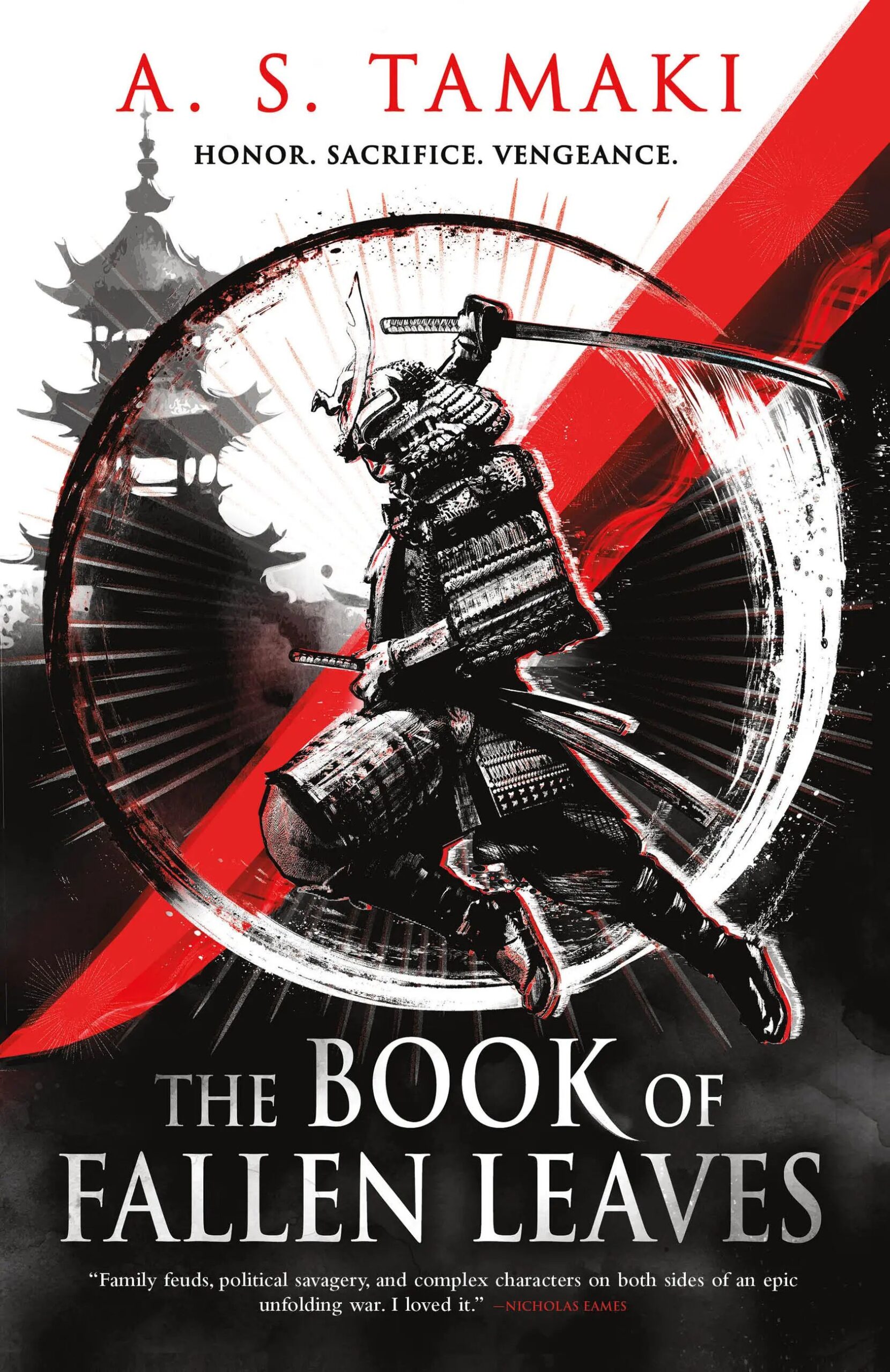
The hold for this book arrived in early April. Like with the debuts of previous weeks, this is my first time reading anything by A. S. Tamaki as it will be for anyone who is reading this book at this time. The edition I read was blurbed by the following authors – Nicholas Eames, Andrea Stewart.
Let’s get into it.
The Book
The Book of Fallen Leaves is an epic fantasy novel through and through. Like its ilk it opens with a map of a fantasy version of Japan. To this book’s credit, I found this particular map useful as the book makes use of various locations on it and I found myself referring back to it often.
This book also opens with two and a half pages of character names and their relation to each other. This immediately instilled a sense of trepidation which brings me to the book’s first major fault. There are too many damn named characters and more importantly, there are too many character POVs. I counted six different unique character POVs, some of them getting more page time than others.
This is a problem that I have noticed previously in two other epic fantasy debuts I read earlier this year namely – A Song of Legends Lost by M. H. Ayinde and Birth of a Dynasty by Chinaza Bado. Both of those also had a large cast of named characters along with multiple POVs and like with those The Book of Fallen Leaves has POVs that I don’t like and ones I do. Thankfully the two main character POVs, Sen and Rui are ones that I do happen to like more than the rest.
This amount of named characters created a secondary problem, which is that I constantly kept losing track of who everybody was in relation to each other. Sometimes this happened while a couple characters are in the middle of an important conversation and I had to go look at my notes where I had transcribed the list of characters down to jog my memory. This broke my reading flow and it meant the reading experience was very stop and start.
The issues with flow was not just relegated to character conversations, it is a problem throughout the book. A. S. Tamaki has a tendency to insert large amounts of a character’s internal monologue in the middle of dialogue scenes which means that all of a sudden there is a character thinking about something from their past in the middle of a conversation and I lose track of what the conversation was even supposed to be about.
At the beginning of the book there was also a problem with what I can only categorize as info-dumping as a way to provide character backstory or explain something about the world. This was also was something that contributed to the flow issue and generally left the prose at the beginning of the book feeling rather stilted. This particular info-dumping problem disappears after the 25% point.
The vast majority of this book’s plot involves political intrigue of some kind or other. This would normally not be a problem, I love political intrigue! However, due to the aforementioned issues with the number of characters and the stilted flow, I had a hard time following what was happening at any given time and thus I wasn’t invested in any particular plot line or character.
The Book of Fallen Leaves is tagged as “challenging” on Storygraph and I agree with that descriptor. The book is challenging to read not because of difficult subject matter but because it is a challenge to get through. It was a slog. Unlike say, Beloved where the payoff for reading the challenging prose was excellent character and thematic work, this book doesn’t have anything of that sort.
Normally, at this point in my review I would go into detail about a book’s themes and characters but in this case I think it would be the literary equivalent of squeezing blood from a stone. I didn’t end up caring about any of the characters or the sprinkling of themes of family, vengeance, and power. All I have to say is that nothing about the way those themes were portrayed moved me.
This is a book I would have DNFed if it wasn’t a debut and didn’t have a promising premise. I gave this book a lot of grace. At many points in the book I considered DNFing the book but I powered through it in the hopes that I would start to have a better time with it at some point. That unfortunately never happened. Chalk that as up another win for the sunken cost fallacy.
Concluding Thoughts
The Book of Fallen Leaves was a disappointment. I really wanted to like this book, the premise and the setting was very much up my alley but the execution left much to be desired. This was the worst of the fantasy debuts I’ve read this year. In a year where I read books like The Poet Empress, Weavingshaw, and The Red Winter the bar for what I consider a good fantasy debut is much higher than it ever was and this book didn’t come close to any of those. Suffice to say, I will not be continuing the series.
Oh, and as far as I can tell this book did not get a hardcover edition in Canada and the paperback edition felt like it was made as cheaply as possible, even more than is typical for paperbacks. The library copy of the book already has some minor wear and tear and the book has been out less than a month.
This I am putting the blame solely on the publisher Orbit for being cheap bastards. I think the book should have gotten a hardcover edition. I don’t think it would have changed my opinion of the contents of the book but such things matter for giving a book the best first impression and putting out a cheap paperback like this out on the initial run feels like Orbit sent the book out to die.
That is all from me. See y’all in the next one.
Thank you for reading this blog post. Please consider supporting my writing work through Patreon. Additionally, please share this post on your socials and/or with your friends. It really helps! If you have any thoughts/feedback/thoughtful criticism to share, feel free to use the handy contact me page to send that to me.