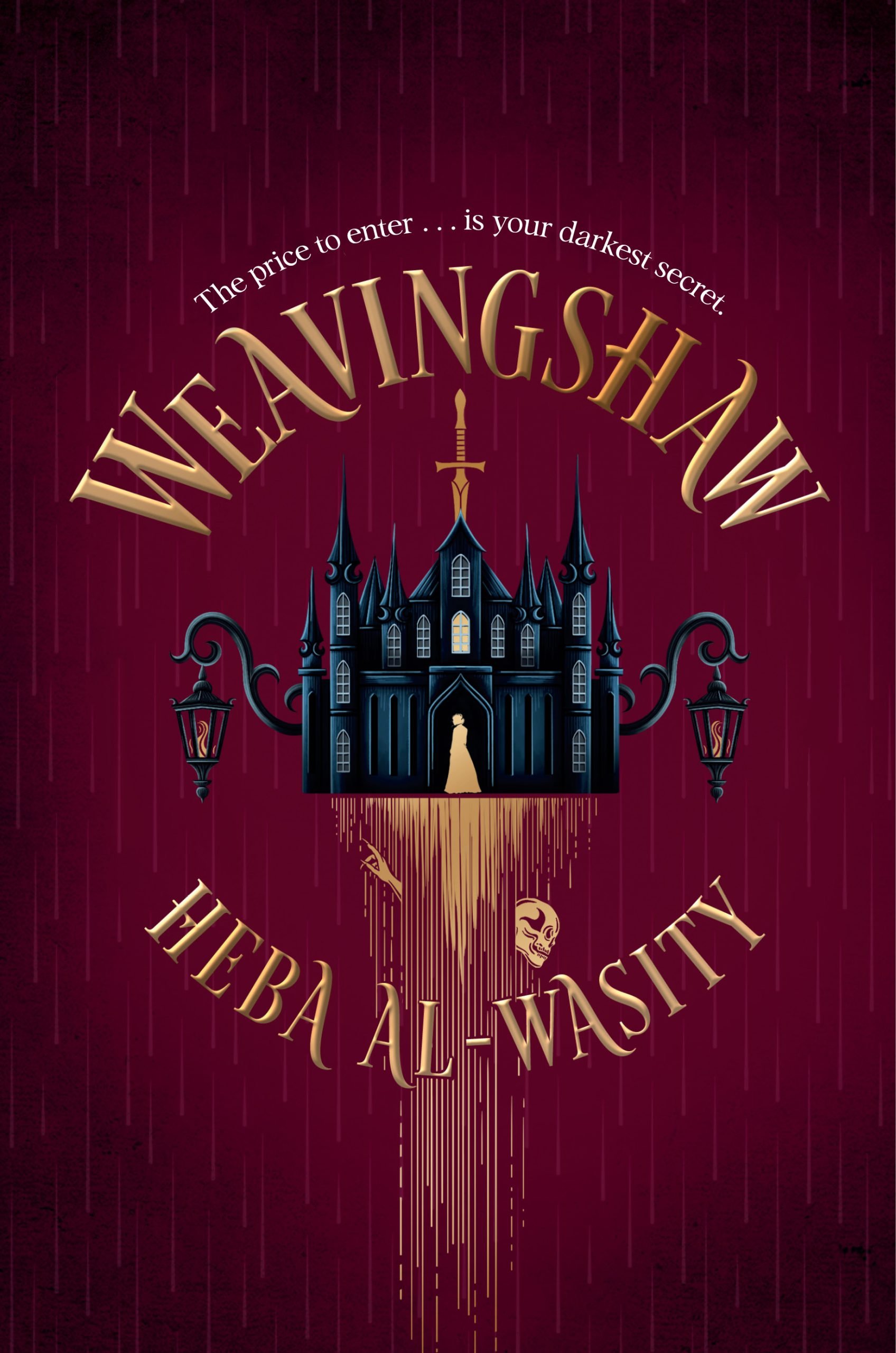
The house was immense, and built like a fortress to withstand violent sieges. More than forty darkened windows watched their insignificant carriage pull up to the front, resembling dilated eyes unblinking in silent judgement. Ivy draped the pale limestone bricks, and wild roses tangled up from the soil. The single turret towered over them, parting the mist. To the left were the burned remnants of a crumbling tower, the walls decaying and blackened. Deathgrips, their still-violet petals a contrast to the dull browns of late autumn, grew like a moat surrounding the house, as if to ward away any wolves that might be growling at the edge of the forest.
page 253
Table of Contents
Why Weavingshaw?
I first heard about Weavingshaw in caricanread’s most anticipated fantasy and sci-fi releases of 2026 video that came out in February 2026. Just like The Poet Empress, this is another fantasy debut with an intriguing premise so I ended up placing a library hold on it.
The hold for this arrived in late March and I started it this past Sunday (29th March) and finished it on Monday (30th March). I had not heard much about this book from other booktuber channels and the only positive recommendation I received was from someone on the fediverse who had read an Advance Reader Copy.
So going into this, I didn’t know what to expect other than what was in the Storygraph description of the book. This is of course my first time reading anything by Heba Al-Wasity as I imagine it is for anyone else reading this book at the time of me writing this review.
Without further ado, let’s get into it.
The Book
Weavingshaw is a gothic fantasy which follows the story of one Leena Al-Sayer who has the power to see the dead, a secret that she cannot reveal to other lest she be locked away in an asylum. Like in The Poet Empress, our protagonist is desperate, in this case she is unable to buy the medicine that her brother Rami needs so she makes the dangerous choice of selling her secret to the enigmatic Saint of Silence.
The majority of the story is told from the perspective of Leena with a few chapters told from the perspective of the Saint of Silence, also known as St. Silas. Before I talk about the main characters I think it is worth talking about the world that this book is set in. Gothic as a descriptor is correct, the vibes are dark, gloomy, brooding even and that is the case from the very beginning.
Allegories and Themes
The story is set in the fictional country of Morland which is a monarch with a class of aristocrats. I think Morland is supposed to be a fictional representation of a monarchist England. The ruling class is painted as despotic and the living conditions of the working class can best be described as bleak.
If things weren’t bleak enough, our main character Leena is the daughter of an Algaraan refugee, a union organizer and revolutionary from the country they fled from. Algaraan is run by a dictator who is only referred to as the Algaaran Malik and is as despotic as the Morish ruling class. I think Algaraan is supposed to be a stand-in for Iraq and the Malik a stand-in for Saddam Hussein; I am basing this on the fact Heba Al-Wasity herself was born an Iraqi refugee in Libya.
So parts of Weavingshaw is a commentary on the experiences of refugees and more specifically the experience of living under an authoritarian regime. The book does a reasonably good job of connecting this theme to our main character and the world she lives in but as the story progresses the importance of this particular theme just sort of becomes set dressing more than anything else and the mystery plot at the core of the book takes center stage.
It feels a tad awkward to have the refugee aspect be very prominent at the beginning of the book and then in the second half of the book, all we get from Leena are a few hamfisted bits of dialogue connecting something to her experience as a refugee. That said, the book doesn’t completely veer away from this theme, it is explored through some of the side characters in the book but I never felt quite satisfied with how the book handled this topic.
My primary frustration with this book is that while it is rather unsubtle with its allegories, it is also inconsistent with exploring them. Unlike say, Babel or Blood Over Bright Haven both of which share some of the same thematic thrust and the unsubtlety, the inconsistency of thematic exploration meant that that aspect of the book felt harried by the main plot which is almost entirely about Leena and St. Silas. It felt uneven. Since this is a debut, I am willing to give a certain amount of grace and I hope this is something that will be better in the next two books.
Mystery Man
Let’s talk about the mystery for a bit. This is where the book really shines. From the very beginning, second main character St. Silas is painted as an enigma, tight-lipped and very careful about what he says and does. His housekeeper is strange and Leena is disconcerted by just how cold the house he lives in is. St. Silas is a key part of the mystery of this book and I loved the way we slowly find out more about him as the story progresses. Like Leena, I constantly wanted to know more about him.
I also really loved the way the relationship between Leena and St. Silas developed throughout the story. From fear and loathing to a slow hesitant opening and understanding of each other. Weavingshaw features an extremely slow burn romance which develops with the intensity of a slow growing fire. I think this book does a superb job of making the development of the romance feel natural and realistic so kudos for that.
The ending of Weavingshaw is also really well done. It neatly wraps up most, if not all of the story threads and leaves us on a bit of a cliffhanger in a way that doesn’t feel unsatisfying but still leaves me wanting more. When I saw that this book is the first in a trilogy, I was a bit worried about how this first book was going to end but the book managed to stick the landing quite well.
Concluding Thoughts
Weavingshaw is another fantastic debut. I don’t think it hit quite as hard as The Poet Empress did for me but regardless of that I very much enjoyed my time reading this gothic fantasy and immersing myself in its world and characters. This is a trilogy I very much want to continue reading and I look forward to reading the second book whenever that comes out.
Also notable is that this is the ninth (!) book I read in March 2026 which means that I have set a new personal record for the amount of books I’ve read in a month.
I am extremely happy to be reading these excellent debut novels. There is just a certain magic to reading an author’s debut and especially if they are really good and happen to be in the genre one usually haunts. The next two books in my reading queue also happen to be fantasy debuts and I am looking forward to sinking my teeth into them.
That is all from me, see y’all in the next one.
Thank you for reading this blog post. Please consider supporting my writing work through Patreon. Additionally, please share this post on your socials and/or with your friends. It really helps! If you have any thoughts/feedback/thoughtful criticism to share, feel free to use the handy contact me page to send that to me.