I had the thought, for the first time in months, that life without death is a miserable gift.
page 4, Sebastian
Table of Contents
Why The Red Winter?
I first heard about The Red Winter from cari can read’s most anticipated fantasy and sci-fi books of 2026 video. At the time what I heard didn’t pique my interest enough to put the book in TBR or on my library holds list. The next time I saw it mentioned was on the 1st of March on the front page of bookshop.org, shortly after its release and it was then that I put in a hold for it.
The hold for this book arrived in late March along with the previous two books I’ve reviewed: Weavingshaw and The Poet Empress. That makes The Red Winter the third debut novel I have read back to back, the library and book goddesses have deemed it be my time to read debuts and so it is.
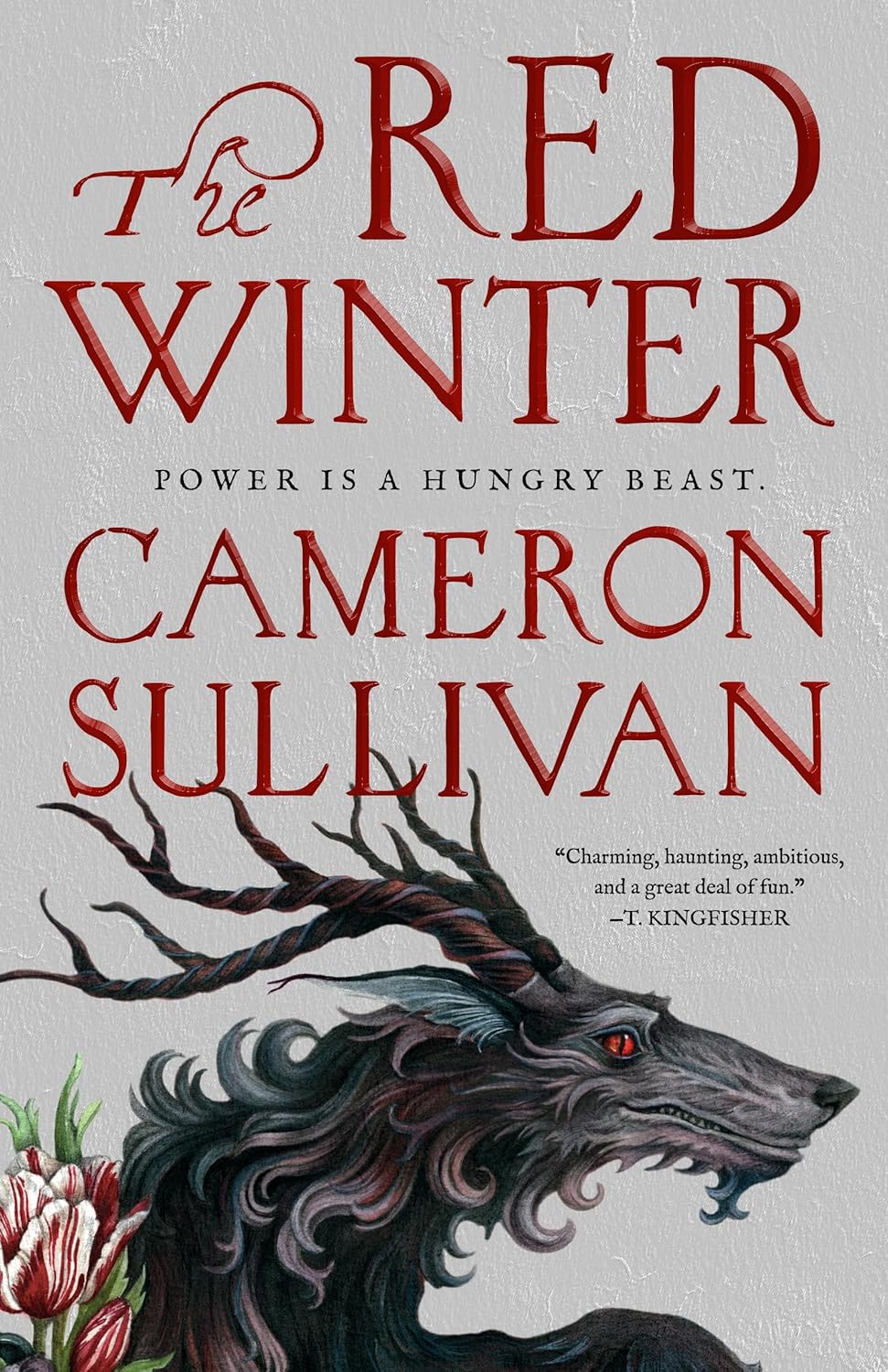
And once again like a broken clock, this is my first time reading anything by Cameron Sullivan, as it would be for anyone else reading this book at this time since it is a debut novel. I’ll also make note of which other authors blurbed the edition I read since I find that kind of thing interesting – T. Kingfisher on the front cover, Alix E. Harrow, Shelley Parker-Chan, and Cassandra Khaw on the back.
Without further ado, let’s get into it.
The Book
The Red Winter is a historical fantasy novel set mostly in 1700s France with brief interludes in 1400s France. More specifically, this novel is a fantastical retelling of the story of the Beast of Gévaudan, which is in itself the origin story of the werewolf as we know it today. I had previously heard snippets of the story of the Beast so I was very intrigued by how the author was going to wrap a fantasy blanket around that tale.
Structure and Style
Most of the story is told from the perspective of Sebastian Grave, an immortal monster-slayer who has been alive since the time of Ancient Rome. There are a few “Addendum” chapters told from the perspective of Livia, Sebastian’s….succubus assistant, these chapters are the ones where the story goes back to events that happened in 1400s France and which just so happens to connect to the events happening in the 1700s.
Within the 1700s, there are two different timelines, the 1766 timeline which is Sebastian’s first encounter with the Beast and with one of the key characters Antoine Avenel d’Ocerne. The other timeline is in 1785 when Sebastian is visited by Antoine’s son Jacques to take him back to Gévaudan after the beast’s return. That first period is the titular Red Winter.
There is one other stylistic aspect that I think is notable here – this is a fiction book with footnotes! This is an extremely rare occurrence, the last time I recall a fiction book making use of footnotes was Emily Wilde’s Encyclopaedia of Faeries by Heather Fawcett. I adore these footnotes, they add very interesting and highly relevant historical and worldbuilding lore to flesh out the world here and as a bonus some of them are very funny.
I want to make this absolutely clear: the Spirit you know as Lucifer, Satan or the Devil hasn’t been seen for several thousand years, thanks to the Almighty and the Host. It is safe to assume he has been consumed. While we are on the subject–the idea of Hell is both impractical and improbable. Please tell everyone you know.
page 115, footnote
Livia’s Addendum chapters were very interesting, namely because they tie in the story of Joanne D’Arc to the events that happen three hundred years later in Gévaudan in a way that I was not expecting and it just so happens Livia’s perspective is a really fun one to read from. She has a sardonic sense of humour to her that provided much needed comic relief in a story that is otherwise quite dark.
Characters
The Red Winter has three main characters of note, two of which I have already mentioned – Sebastian Grave, and Livia. The third is Sarmodel, Sebastian’s indwelling spirit who is described as being a male spirit with many aliases over the centuries (Nott, M’quet, and Lariel). He is perhaps the most interesting of the three characters to me mostly because he is such a mystery.
Sebastian’s contract with Sarmodel makes him immortal and this is where I think it is important to mention the importance of Contracts in this fantasy world. I’ll let one of the footnotes explain.
Contracts are the chief means of interaction between the Spiritual and Mundane realms. Truth is one of the most common, but Contracts can govern the exchange of almost anything, including information, money, services, or anima. They’re the main way Sarmodel and I put food on the table, quite literally.
page 10, footnote
I think it is important to mention these magical contracts because they define the interactions between all three of our main characters. Sebastian and Sarmodel have a contract. Sebastian and Livia also have a contract that in essence compels Livia to do as Sebastian orders. The exact details of these contracts are mostly not mentioned and especially the details of the formation of Sebastian and Sarmodel’s relationship are left a mystery.
I love all three main characters here, they are all interesting their own way and all their quirks and foibles make the story more fun to read. Sebastian at times comes off as a tad arrogant as someone who has lived for hundred of years can be, but that experience also gives him a unique perspective on the events happening around him. And it just so happens that his immortality does not make him immune to mortal foibles, namely falling in love.
The Love Story
The Red Winter has a few different things going on, there is of course the Beast and a story about monstrosity. There is also commentary on the nature of immortality. There is the undercurrent of the nature of class differences between the nobility and the peasants. This is pre-revolutionary France and we see aspects of what injustices and inequalities led to heads getting chopped off.
At its core is the beating heart of a queer love story. As Sebastian tells more and more of his time in Gévaudan, we learn the details of his interactions with Antoine Avenel d’Ocerne who he slowly but surely fell in love with. And this is where the scene is set for a tragedy, and oh what a tragic love story it is.
An immortal falling in love with a mortal and it ending in tragedy is in itself not a novel idea but this book executes that trope so very well while at the same time wrapping the story in the dark blanket of a story about power and monsters. This is a dark story and that darkness extended to the love story as well.
As the story progressed, I knew that this queer love story was headed for a tragic end but I did not know just how Cameron Sullivan would make the landing happen. I think he did a sublime job of it. I’ll let a quote from the book demonstrate.
“Then I will tell you what I see. You are the man who brought my son home safely, when he was already half a monster. You are the man who followed me to the riverbed, and the one I kissed under the maple. You are the man who came to find me in the dark when I was losing myself. You are the man who bargained with a monster–twice–to save my life. You are the man I wanted to rebuild Gévaudan with–sugarcane and cinnamon, remember?”
page 517, Antoine to Sebastian
This heartbreaking moment had me in tears and mourning a love that was never meant to be. Despite the book’s Storygraph description mentioning a tragic love story being present I didn’t remember that going into it so this love story hit me like a truck. I dare say that this fantasy novel does a much better job of telling a love story than a lot of other fantasy-romance or romantasy novels.
Concluding Thoughts
The Red Winter was an incredibly good read. A well written story about power, monstrosity, and love that once it had gripped me in its talons, I didn’t want it to let go. I enjoyed everything about this book, the narrative, the characters, the fantasy world, and most of all the tragic love story. This is one of those books where I felt a bit sad after I finished it because I wanted to live in the world it had created for just a bit longer.
Once again, a debut that had me extremely impressed. Cameron Sullivan in the Acknowledgements sections of the book hinted that we are going to be getting more stories with Sebastian, Sarmodel, and Livia and I very much look forward to reading these stories whenever they come out.
The Red Winter is now the sixth entry in my 2026 Books of the Year list. It is also the third debut novel to make the list alongside Woodworking by Emily St James, and The Poet Empress by Shen Tao. It has been an exceedingly good year for debuts and I continue to very happy about that.
I’ll leave y’all with another very funny footnote quote.
This was a joke–the Archangel has come to the flesh only once (ref. Luke 2:1-20) and we all know how that ended up.
page 389, footnote
That’s all from me, see y’all in the next one.
Thank you for reading this blog post. Please consider supporting my writing work through Patreon. Additionally, please share this post on your socials and/or with your friends. It really helps! If you have any thoughts/feedback/thoughtful criticism to share, feel free to use the handy contact me page to send that to me.