The accusation of failure isn’t one we should level against the Bund, or any other Jewish group of that place and time. It’s for the Western world of which they were such a precarious part. It was the West, after all, that hypocritically paid lip service to freedom and humanity while hewing to the crude doctrines of might. The true failures were the democracies who played nice with Hitler in the early years, then shut their doors to Jewish refugees who fled from the hell they helped enable. The failures were the British and American diplomats who hobnobbed in Bermuda while the ghetto burned.
page 381, Postscript
Table of Contents
Why Here Where We Live Is Our Country?
I first heard about Here Where We Live Is Our Country from a two-part series of the Cool People Who Did Cool Stuff podcast on the Jewish Labor Bund in which the host Margaret Killjoy discusses the Jewish Labor Bund with the author Molly Crabapple. I was intrigued enough by the topic to put the book in my to-be-read pile at the time.
I put in a library hold for the book closer to its release and received the book earlier this month. Despite this, I had originally planned on returning the book to the library unread as after having read one heavy non-fiction book within the last month, I was not in the mood for another.
But since another fiction book I borrowed from the library ended up being a DNF, I decided to start reading the book on Thursday, the 18th of June and it kept me interested enough that I continued reading it on Friday and I ended up finishing the book on Saturday after spending the entire day reading it.
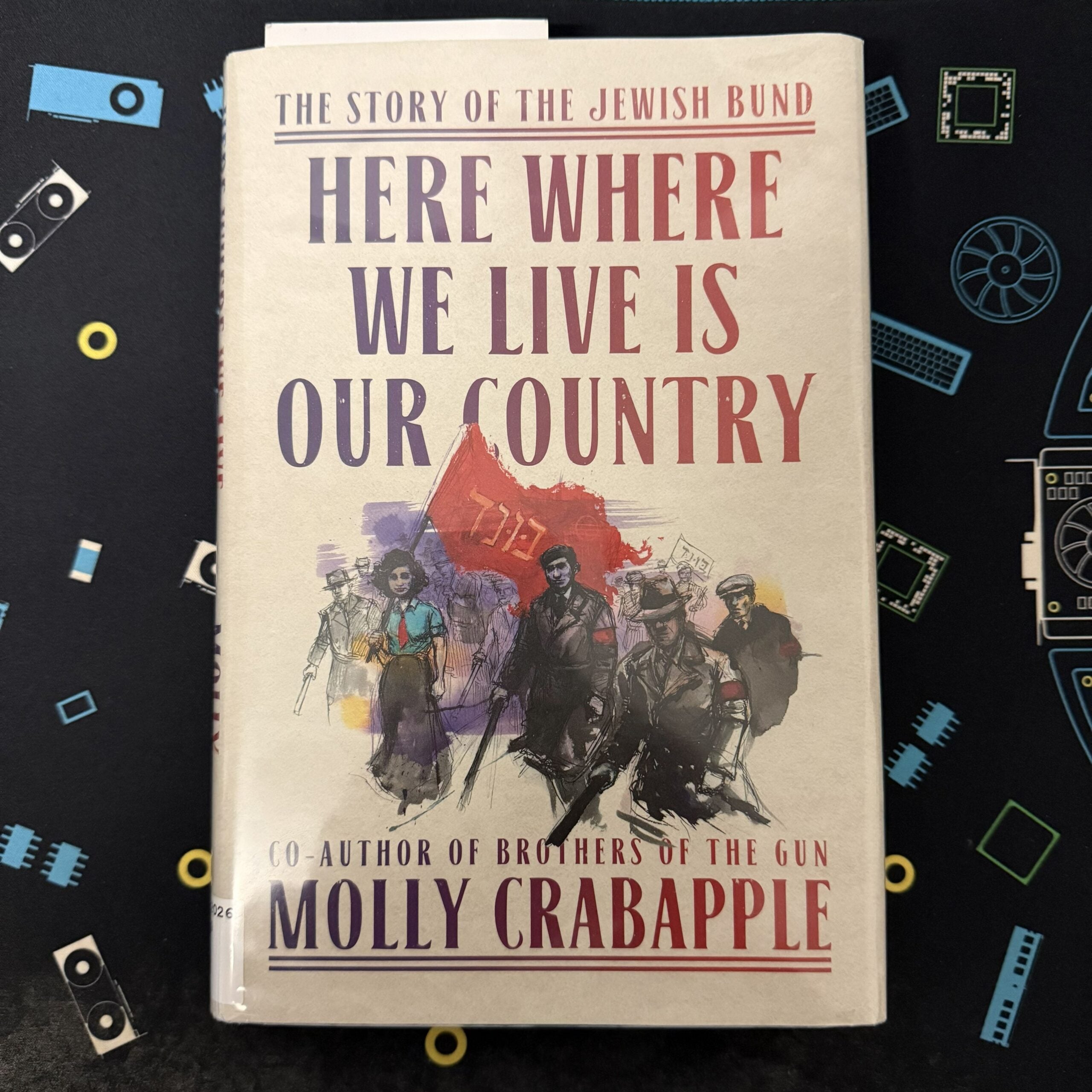
This is my first time reading anything by Molly Crabapple. I read a hardcover edition (ISBN/UID: 9780593229453) published in April 2026 by One World, an imprint of Penguin Random House. Author blurbs on this edition are from – Naomi Klein, Pankaj Mishra, and Jason Stanley.
Like with other non-fiction books, I’ll be separating some quotes using paragraphs where they don’t originally exist for the purposes of readability.
Let’s get into it.
The Book
Here Where We Live Is Our Country is a non-fiction book that tells the story of Jewish Bund from its origins in 1897 to just after the end of World War II, after which point the Jewish Bund fragmented into smaller pieces all over the world with the only currently surviving chapter of the Bund being in Melbourne, Australia.
The book is written in a narrative style reminiscent of fictional novels. Molly Crabapple wisely eschews the dispassionate style that academic historic books are prone to and opts for a far more accessible and dramatic telling of the Bund’s story. The story of the Bund is the story of a large number of people and the book opens with a long list of the cast of characters involved.
I very much liked the style the book was written in. I found the prose easy to read and the complex narrative reasonably easy to follow due to the more accessible style. If this was yet another dry academic history text I don’t think I would have finished reading it. Molly’s own opinions on the Bund and the historical connections to contemporary politics is also made clear through the book and that is something I appreciated.
The Bund
Before I start talking about what I think of Here Where We Live Is Our Country more broadly, it is important to set the scene for who the Bund actually are. This was my first time encountering this term and this group which was one of the reasons this book piqued my interest in the first place.
I’ll let Molly do the explaining as she does a bang up job of summarizing what the Bund is all about.
Founded in 1897 in the city of Vilna in the Russian Empire, and reaching its height in interwar Poland, the Bund was a sometimes-clandestine political party whose tenets were humane, socialist, secular, and defiantly Jewish. Bundists fought the tsar, battled pogroms, exalted the Yiddish language, and built vast networks of political and cultural institutions out of little more than love and grit. Seeking to liberate Jews from the poverty and violence of interwar Poland, they raised their children on the radical ethos of working-class solidarity and subaltern pride. Ultimately, these youth helped lead the Warsaw Ghetto Revolt.
Though the Bund was largely obliterated by Nazi Germany and the Soviet Union, the group’s opposition to Zionism better explains its absence from current consciousness. Though the Bund celebrated eastern European Jews as a people, they irreconcilably opposed the establishment of a Jewish state in Palestine. The diaspora was home, the Bund argued. Jews could never escape their problems by the dispossession of others. Instead, Bundists created the doctrine of do’ikayt, or “Hereness.” Jews had the right to live in freedom and dignity wherever it was they stood. They would fight for a better and more beautiful world, even alongside people they had been raised to see as enemies.
page XX, Introduction
The key concept that this book and its narrative about the Bund is centered around is this concept of do’ikayt or “Hereness”. This doctrine informs all of the Bund’s other stances, including their principles of participation in local political and social institutions, mutual aid, self-defense, working class solidarity, and of course anti-Zionism.
Zionism
The conversation between Herzl and von Plehve illustrates the Bund’s problem with Zionism. Zionism was not just impractical, in Bundists’ eyes. It was submission to the same bigots who wanted to kick Jews out of their homes. The Bund believed that Jews belonged in eastern Europe.
“We are not strangers here and not guests, even though the Russian government considers us as such,” one local Bund committee wrote. “The richness of the land is soaked through with our blood….We demand and fight for that which belongs to us, for human, civil and political rights.” To leave meant letting their tormenters win. The Bund coined a word for this stubborn insistence on staying: do’kayt. Hereness, as opposed to the There of Palestine. Bundists would fight for freedom and dignity in the place where they lived.
page 53, Chapter 4: Rivalries of Exile (1903-1904)
One of the core principles of the Bund was a form of anti-Zionism. This is where things get a bit murky. Anti-Zionism as we understand it now is not the same as it was in the late 1800s and the early 1900s. Zionism itself is not a monolith with divisions between Labor Zionists and the later Revisionist Zionists occurring within this period. YIVO’s encyclopedia provides a good overview of the history of Zionism throughout the years.
In chapter 16 of Here Where We Live Is Our Country Molly provides a brief overview of these two branches of Zionist ideology.
This is on Labor Zionism:
The Marxist Dov Ber Borochov developed the Labor Zionist philosophy in the same late-nineteenth-century ferment that produced the Bund and organized the political party Pole Tsion to carry out his ideas. According to Borochov, Jews’ minority status in Europe prevented them from embarking on productive work (by this he meant shirtless hammer-swinging) and relegated them to their stereotypical roles of tailors and money lenders.
Jews could only become proper proletarians if they established a Jewish state in Palestine, where Jewish capitalists would exploit Jewish proletarians until class war broke out and the Jewish proletarians gloriously created communism. Borochov thought that since Jews and Arabs were cousins, Palestinians would be perfectly happy with this plan. To back up this dubious point, he brought up the friendship between African Americans in Liberia and the Kru people they colonized. (These African American settlers would later bring plantation slavery to their new West African home.)
page 182
This is on Revisionist Zionism:
Labor Zionism’s main rival was Revisionist Zionism, which, as propounded by its founder, the Odesa-born journalist Vladimir Jabotinsky, wanted a Jewish state that didn’t just stretch from the river to the sea but even encompassed contemporary Jordan. Like Borochov and Ben-Gurion, Jabotinsky came up in the same milieu as the Bund. He even briefly dated the young Sophia Dubnova before her marriage to Henryk Erlich.
During the revolution of 1905, the Bund’s self-defense militias impressed Jabotinsky, leading him to view Bundists as his greatest rivals. In one polemic, he wrote that the Bund’s heroism was a waste. Jewish revolutionaries died to make history on behalf of an alien people Russians, who would just as soon have them dead. Once the revolution spread, Jews were doomed to be forgotten. “The Jewish revolt was only terrifying to the government because it was a match which could set the Russian heartland afire,” Jabotinsky wrote. “When all Russia is ablaze, who remembers the match?”
page 183
Of note also is that while Bundists and Zionism were at odds on the matter of Jewish settlement elsewhere they were not entirely opposed to working together on other concerns namely the preservation of the Yiddish language using education. More specifically, I am referring here to TSYSHO aka Di Tsentrale Yidishe Shul-Organizatsye (Central Yiddish School Organization) which. For further context Po’ale Tsiyon (Workers of Zion) is a Labor Zion organization.
Di Tsentrale Yidishe Shul-Organizatsye (Central Yiddish School Organization), commonly known by its acronym, TSYSHO or CYSHO, was established in Warsaw in June 1921. Led primarily by members of the Bund and Left Po‘ale Tsiyon, its founders sought to create a network of secular Yiddish schools under socialist auspices.
Bund – YIVO Encyclopedia
Suffice to say that the relationship between the Bund and Zionist movements of the past is a little bit more complicated than just “the Bund was anti-Zionist”. History such as this is often messy and complicated because people don’t always cleanly map onto particular ideologies.
There is also the matter of the contemporary old-school Bundist chapter in Australia and the Neo-Bundist movement, the latter of which has taken up the anti-Zionist ideals of the old Bund. The anti-Zionist ideals of the old Bund withered away to a large extent after the events of the Holocaust.
The manifesto of the new Bund, however, draws the comparison between “the devastation of Gaza” and the fate of Jews “in the Ghetto walls,” but does not mention the Hamas attack. Nor does its call to “remake the Jewish Labor Bund” discuss labor issues. A Zoom call with 10 members of the new Bund made it clear that they are attracted to a Bundist anti-Zionist legacy that the actual Bund no longer maintains.
In the story of two Jewish Bunds, a stark generational divide over Israel by Andrew Silverstein
Here Where We Live Is Our Country doesn’t fully address the complicated nature of the Bund’s anti-Zionism. This is not surprising, considering the book’s synopsis and description paint the Bund and their anti-Zionism as something that cleanly maps onto contemporary anti-Zionist and pro-Palestine movements which I don’t think it quite does. There are lessons to be learned from the Bund and their revolutionary zeal and ideologies of mutual aid and self-defense but I think contemporary anti-Zionism’s core is best built on a foundation of other anti-colonialist ideologies.
It is now fully clear to me why Zionism as an ideology continues to be very appealing to Jews both past and present. Here Where We Live Is Our Country addresses this particular point directly.
They joined the flood out of Poland. Zionist smuggling networks crisscrossed the country, helping Jews flee to American-occupied Germany and, from there, to Palestine. One of their most charismatic representatives was Antek Zuckerman, founder of the Jewish Combat Organization. After everything he’d seen, Antek had even less respect for the Bund’s ideology of Hereness, which he damned as a self-destructive delusion.
Anyone could see that Jews had no future without a state. Antek’s wife, Celina, had already left for Palestine, where she gave birth to their child. He joined her there in 1948. The two heroes of the uprising spent the rest of their lives on a kibbutz for ghetto fighters like them, built on the ruins of a Palestinian village, ethnically cleansed by Zionist militias that became the IDF.
page 364, Chapter 27: Scatter (1945-1948)
In the aftermath of a genocide, an ideology that promises safety, security, and the assurance that such a thing will never happen again has dangerous appeal and that is what Zionism offered to the Jewish survivors of the Holocaust. It is no wonder that Antek Zuckerman had no respect left remaining for Bundist ideology considering what he and the JCO had just been through in the Warsaw ghetto.
And Molly then concludes that point with the following:
Maybe it’s this. An oppressed people’s beliefs are not benign just because they lack power. Beliefs are good or bad on their own merits, because nothing stays the same. Demographics change. Empires weaken. Insurgents take charge. Without a clear set of ethics that respects human life, today’s victims transform into tomorrow’s killers. Oppressed becomes oppressor the moment the power flips.
page 372
Marxism and Leftist Infighting
In his 1902 pamphlet What Is to Be Done, Lenin spelled out his belief that only a ruthlessly centralized party of obedient professional revolutionaries had a chance of seizing power in Russia. Meanwhile, the Bund had developed in the opposite direction, preaching that a decentralized coalition of autonomous groups would do the best job at revolution. In this they were consistent. When the Bund co-founded the RSDLP in 1898, they were the largest, best-organized socialist group in the Russian Empire. The Bund entered the new party as an autonomous entity whose turf was the Yiddish working class. They meant to keep their turf exclusive.
page 47
No story about a leftist group is complete without incorporating some amount of leftist infighting. The Bund was a Marxist group and in being Marxist almost to a fault, they clashed with the Bolsheviks of Soviet Russia. In this case, leftist infighting turned violent with several members of the Bund exiled, imprisoned or otherwise purged by Stalin and Soviet secret police.
In addition to that, the Bund’s adherence to Marxist doctrine led to some big mistakes early on.
But instead of sensing the popular mood, Liber and his fellow socialists who ran the Soviet grew more conservative, hewing ever more closely to Kerensky’s provisional government. These former radicals now spoke of patriotism and moderation and postponed their old promises of world peace and eight-hour workdays to an ever more distant tomorrow. This earned them the ironic nickname “right-wing socialists.” Obliviously, most Bundist leaders did the same. If Marxist theory told them that Russia needed a capitalist government, and that socialists could not seize power in Russia in 1917, they would follow that theory to the end.
page 131, Chapter 11: Revolutionary Discontents (May-October 1917)
Those of you familiar with this period of Soviet history will know what happened to Kerensky’s provisional government shortly after this. Spoiler warning: it doesn’t stay in power for very long.
Here Where We Live Is Our Country makes the compelling case that the Bund was in equal parts destroyed by the Nazis and the Soviets. They were fighting a war on two fronts, both Nazis and Soviet secret service agents hunting Bund members. It is a miracle and a testament to the Bund’s organizing capability and sheer grit that they got as much done as they did.
Concluding Thoughts
Reviewing Here Where We Live Is Our Country was a bit of a challenge. This book is very dense. Not only is there are a large cast of characters involved, a lot happens in the duration of time that the book covers. Too much for one single book review to cover in its entirety so I opted for something more manageable, focusing on what I thought were key aspects of the narrative Molly was putting forth – the Bund and its anti-Zionism, and the eternal leftist struggle of fighting fascists and also other leftists.
Reading this book was one hell of a journey from start to finish. Molly Crabapple did a fantastic job telling the story of the Bund, I was emotionally invested in the narrative from the beginning and there were points in the story where I teared up due to what happens to some of the characters. The last quarter of the book is bleak reading but that is to be expected when the story becomes about survival in the Warsaw ghetto, Nazi death squads and all the rest.
Overall, I found the book to be educational and informative. Before this, I had no idea who the Bund was and as such a lot of this history was not known to me. It was also inspirational, the sheer resilience, grit, and organizing capability of the Bund provides a great deal of inspiration for what is required for the tumultuous times we live in. Fascism is on the rise worldwide and the Bund’s history provides a lot of lessons on what to do (and what not to do).
All that said, I think I am going to take an extended break from reading any non-fiction for the duration of this summer. This and The Brutish Museum has left me exhausted and wanting to read fun fiction for a while so I’ll be doing just that.
That’s all from me, see y’all in the next one.
Thank you for reading this blog post. Please consider supporting my writing work through Patreon. Additionally, please share this post on your socials and/or with your friends. It really helps! If you have any thoughts/feedback/thoughtful criticism to share, feel free to use the handy contact me page to send that to me.