“People like that,” Saladin mumbled, “people who have only ever believed that they are superior merely by existing, that they are owed things they did not earn and can take what they want, they will never admit defeat. People like Duarte are incapable of accepting defeat.”
page 109
Table of Contents
Why Aicha?
I first saw Aicha in bookshop.org’s Indie Next List Books for April 2026 and since I continue to be on the hunt for debut fantasy novels, I put it in my to-be-read pile and I also put in a library hold for the book, this was in early April. The book’s hold arrived in mid-April. I read a a paperback edition, there doesn’t appear to be a hardcover release outside of UK/EU at this time.
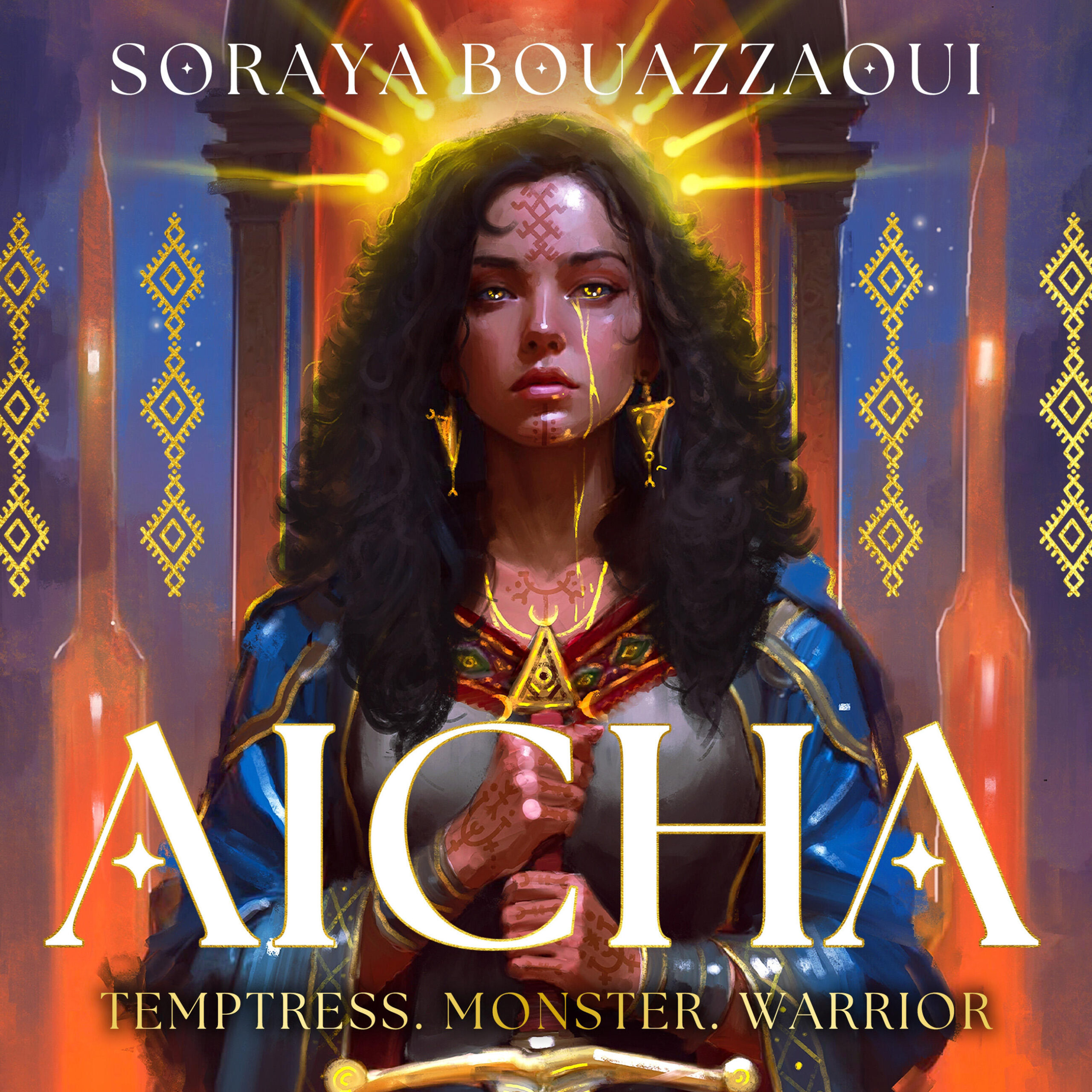
A couple things caught my eye with this book. First, it has a stunning eye-catching cover. Kudos to the cover artist and illustrator because their work is doing a lot of the heavy lifting of selling this book. Second, the premise of the book – a anti-colonial narrative based in Morocco and involving the Portuguese colonizers. I always love a good anti-colonial narrative in my fantasy and I haven’t read one that covered the colonization done by the Portuguese specifically.
This is of course my first time reading anything by this author as I would imagine it is for anyone else reading this book at this time. Author blurbs on the front – Esmie Jikiemi-Pearson. The back is blurbed by Holly Race, Aamna Qureshi, Ellis Hunter, and Eliza Chan.
I commend the author for including a list of content warnings in the author’s note at the beginning of the book. I very much appreciate this and I am sure others do too, I’ll quote it here. In addition to that, the author notes that the one graphic sex scene is entirely contained in chapter nineteen in case anyone wants to skip it (I did).
Traumatic childbirth, death during childbirth, racism, islamophobia, murder, implied sexual assault by settlers, implied torture by settlers. Violent torture referenced. One graphic sex scene.
Trigger Warnings in Author’s Note
Let’s get into it.
The Book
Aicha is a fantasy novel that tells the story of the titular Aicha, the daughter of a freedom fighter who after witnessing the horrific acts committed by the Portuguese colonizers against her people becomes a terrifying revolutionary herself. At it’s heart, this book is a character study of Aicha, one of a slow boiling transformation over the course of several days before the siege of the citadel town Aicha lives in.
Most of the book is told from Aicha’s perspective with a few memory interlude sections from the perspective of her father or her lover Rachid. These memory interludes are denoted by being fully in italics, a stylistic choice that I found helpful. There is a small cast of characters here – the main character and her family, notably her sister Samira and her father Fouad. Also notable is her love interest Rachid.
I liked the characters in this book. Aicha herself gets the vast majority of the character development and page time and she is a fun character to read from the perspective of. She is smart, spunky and doesn’t hesitate to talk back to the Portuguese colonizers harassing her, sometimes to her own detriment. Her father’s love for his daughter is also rather heartwarming and there were some interactions between Aicha and Fouad that legitimately had me in tears.
Rachid, Aicha’s love interest is..fine. I can see why our main character fell in love with him but personally I wasn’t really into him as a character. A bit of this is my general aversion to romance subplots in fantasy novels. Aicha‘s particular romance did nothing for me and I think the story would have been better served if the romance was eliminated and the focus redirected to Aicha and her camaraderie with her people and her freedom fighter friends.
As far as the fantasy elements are concerned, I felt a bit shortchanged. This book’s story has very light fantasy elements, namely in the form of the shawafas – women who are able to see and connect with the supernatural world of jinn and perform divination. There is also the spirit that seems to be in Aicha herself and constantly goading her on towards more violent acts. That’s about it, I really wanted a little bit more magic and mythology than what I got.
I did like the bits of Moroccan culture we got sprinkled throughout the book – the use of Darija Arabic, a dialect of Morocco; the citadel town that is unnamed throughout the book is inspired by the city of Jedida, formerly known as Mazagan during the Portuguese occupation of Morocco. I think the book did a reasonably good job of painting the world that our main character inhabits especially through her interactions with the people around her.
As a story of revolution and anti-colonial violence, I think it did a pretty good job along those fronts as well. As the story progressed, I could feel my rage against the Portuguese colonizers slowly building up alongside Aicha’s own rage. I watched the various injustices, the cruel commander of the citadel Duarte inflicted on the local populace and it made my blood boil and I kept wishing that Aicha could rip them apart, just like the voice in her head kept telling her to.
The primary weakness of this book is not a large one. This is a debut novel and I could tell. Parts of the prose felt awkward and a little bit stiff in places, as if it was uncomfortable in its own shoes. Soraya Bouazzoui also seems to have a liking for similes, as they were a tad overused. For the most part Aicha maintained a rapid pace and that meant that this book was easy to get through, despite its heavy subject matter.
Concluding Thoughts
I thought Aicha was a better than average debut. The book did a fairly good job at developing its main character and kept a tight focus on her story and the world around her. Thematically, this focus was also to its benefit, giving the book a good sense of progression in the form of the pot of anti-colonial violence slowly boiling until it spills over.
I would love to read more from Soraya Bouazzaoui, especially if it involves fantasy involving Moroccan mythology and culture. That is not a cultural perspective we get in English language fantasy all that often and I think we need more of it, please and thank you.
Once again, like with The Book of Fallen Leaves, I would like to call out Orbit for being cheap bastards and not doing a worldwide hardcover release for this book. I really think this does a disservice to debut authors. First impressions matter and people do indeed judge books by their covers. The cover design on this book is stunning but I really wish it was on a hardcover here in Canada.
That’s all from me, see y’all in the next one.
Thank you for reading this blog post. Please consider supporting my writing work through Patreon. Additionally, please share this post on your socials and/or with your friends. It really helps! If you have any thoughts/feedback/thoughtful criticism to share, feel free to use the handy contact me page to send that to me.