Resistance, in the Western mind, is not defined by the act itself, that is, defending oneself or one’s community against an oppressive force. Rather, resistance is defined on the basis of its perpetrators.
page 62
Table of Contents
Why Perfect Victims and the Politics of Appeal?
I first found out about Perfect Victims and the Politics of Appeal in a book club discussion on lexi aka newlynova’s Patreon page. The discussion was about a book I had read in 2025 and was one of my books of the year – One Day, Everyone Will Have Always Been Against This by Omar El Akkad.
In that discussion, someone suggested this particular book as further reading. Over the past few years I have been interested in reading more books about Palestine, I have already a few of the popular ones already. So when I saw this suggestions, I immediately put the book in my to-be-read pile and put in a library hold for it.
I put in the hold in early March and got the book in late April. This is the third non-fiction title I have read this, previous I had read The Fire Next Time in February and The AI Con in March. I am trying to read at least one non-fiction book a month so I am glad to be able to read this in April.
Let’s get into it.
The Book
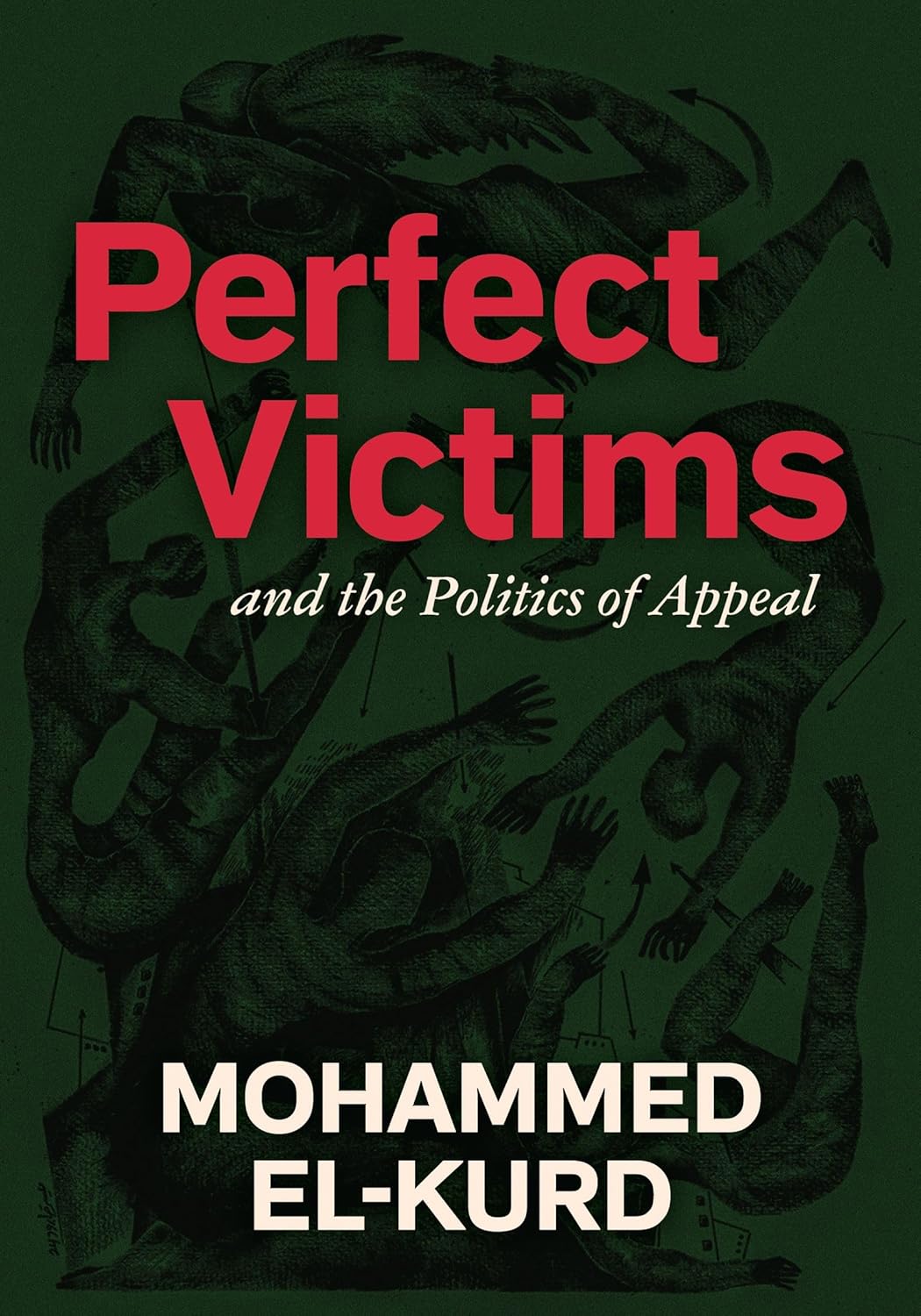
Perfect Victims and the Politics of Appeal is divided up into nine separate essays each tacking a different sub-section of the broader remit of the book which is the Palestinian as the perfect victim and the politics of appeal. The book starts of off with nine numbered notes about the book and way it is written.
The most important of these is the book is not meant to be a critique per se, and in Mohammed El-Kurd’s own words:
Rather, it is an interrogation of strategies and tactics, ideologies and impulses, and hypotheses and beliefs, an infiltration of the dominant discourses.
page 2, author’s note 4
Note number 7 also mentions that this book shifts between Arabic and English (usually in footnotes), poetry and prose, journalism and political activism etc. All-in-all there is a fair bit of tonal shifting throughout the book, I found the shifts to be seamless and Mohammed moves between his various selves of writer, poet, and journalist with an ease that I am a little bit jealous of.
As with previous non-fiction book reviews I will review all of the essays and add my commentary on them. So there will be a lot of quotes. There are a lot of quotes from this book in my notes and I will be making ample use of them in my review.
the sniper’s hands are clean of blood (on dehumanization)
The first essay in Perfect Victims and the Politics of Appeal is about dehumanization as the sub-heading makes clear. It is important to note that when Mohammed refers to dehumanization, he very specifically means this:
When I speak of dehumanization, I am referring to a phenomenon more implicit, yet far more pernicious and institutionalized, a practice perfected by our politest murderers. When I speak of dehumanization, I am referring to the West’s refusal to look us in the eye.
page 14
This is also where Mohammed El-Kurd brings in the metaphor of the sniper. Well, I say metaphor but there are in fact real actual snipers who murder Palestinians. But in this case, the author expands the use of the word to metaphorically describe a fairly diverse group of people who are just as complicit as the Israeli sniper firing their rifle.
And the snipers are everywhere: the underhanded journalists, the spineless bureaucrats, the inconspicuous henchmen, the philanthropists who mine our tragedies for gold, the television anchors who obfuscate those tragedies, the missionaries who find their salvation in our demise, the devil’s advocates, the distractors, those who litter our roads with red herrings, the unscrupulous political advisors, the activists who act as puppet masters, the elite capturers, the elitists in our ranks who demand of us a certain dance, who imprison us in the panopticon of their gaze, the self-appointed intellectuals, the clergy who whisper when they should scream, the very well-fed weapons manufacturers and the university administrators who feed them, and the academics indulging in arrogance and willful misinterpretation, who mutilate Frantz Fanon and Walter Benjamin, deny human nature, and contest even the laws of physics in order to pathologize our resistance. In this reality, the sniper’s hands are clean of blood, but his body count is insurmountable.
page 15
This particular metaphor is one that Mohammed El-Kud uses throughout the book so it is one that is important to keep in mind.
the politics of defanging (on “humanization”)
On the flip-side, the second essay in Perfect Victims and the Politics of Appeal talks about how the Palestinian’s humanity is relegated to a very specific narrow subset. This so-called humanization Mohammed posits is a form of defanging, a way of removing and/or smoothing over the rough edges that exist within a people who have been oppressed for more than a hundred years. Well-intentioned or not it serves to turn the Palestinian into an appealing perfect victim.
SO WHAT IS HUMANIZATION? An aspirational sensibility? A colonial divide-and-conquer strategy doing the exact opposite of what it purports to do? A malevolent devalorization? An honest effort to counter the anti-Palestinian racism running rampant in the mainstreams of the West? If we think about humanization as a “well-intentioned” project we then can define it through its supposed objectives. Humanization seeks to undo implicit or explicit biases ingrained against “the Palestinians” through depicting us in “respectable” and “relatable” terms, often with an emphasis on individuality or, if a group, the passivity of said collective. Correspondents, cultural workers, our allies, and, of course, we ourselves have long adopted this framework as the foundation of our representational processes: compelling pathos to divorce us from our sullen, menacing stereotype; ethos for credence and credibility; and the exhausting, tedious recitals of facts and statistics in the face of coherently incoherent propaganda. I won’t go as far as to call it logos.
page 35
shireen’s passport (on the invention of the civilian)
The third essay in Perfect Victims and the Politics of Appeal tackles just how the perfect victim aka the civilian is created. Mohammed posits that certain people with certain passports are supposedly perfect victims and yet even with all the myriad privileges an American passport gives you – protection from Israeli munitions is not one of them.
The logic is straightforward: certain citizenships can transform the slain—usually a number in a given statistic— into a person of blood and flesh, a victim worthy of sympathy. The bald eagle embossed on Shireen’s travel documents would make her even more worthy. Though not one to turn the other cheek, she certainly fit the obligatory profile of a perfect victim: a 51-year-old woman, a Christian, a journalist who was killed while wearing a clearly marked press vest and helmet, and a foreign national. Americans might die by the rifle of a “troubled” teenager in school hallways, but very rarely by the rifles of a foreign army. Palestinians, on the other hand, are shot every day with impunity. Barely three weeks after Shireen’s assassination, Ghofran Warasneh, a reporter from Hebron’s Al-Arroub refugee camp, was killed by the Israeli occupation forces as she was on her way to work. Despite being a journalist, her killing barely made a splash in the Arab world, let alone in the West.
page 53
This essay also interrogates the role of the media in how victims of Israeli state violence are portrayed. The difference between a Shireen and a Ghofran is night and day.
When it comes to Palestine, the sacred laws of journalism are bendable. Optional even. Passive voice is king. Omitting facts is standard. Fabrication is permissible. Journalists become stenographers, and reporters become state secretaries, as they parrot police and military narratives. They tamper with evidence. They muddle, mislead, and misconstrue, manufacturing consent for ethnic cleansing and creating confusion around murders that are clear as day. The courageous industry that boasts of speaking “truth to power” is but a bullhorn for the powerful. We have seen this time and time again. It is almost satirical: anchors reject the data before their eyes to recite lies, and newspapers read like caricatures of themselves. When a 2014 Israeli airstrike on a cafe in Gaza blew eight Palestinians to shreds, the headline from the New York Times was “Missile at Beachside Gaza Cafe Finds Patrons Poised for World Cup.”‘ Whose missile? Whose gunfire? Who is the sniper?
page 58
This essay also reminded me that of all the journalistic snipers out there running cover for Israeli war crime, none are the bigger and more well established than the New York Times. Which is why I personally do not read the NYT and I do not share their articles. I think if you subscribe to them directly, you should unsubscribe.
a life in cross-examination (on forbidden sentiments)
The fourth essay in Perfect Victims and the Politics of Appeal talks about so-called forbidden sentiments, the language that the Palestinian is not allowed to use. It also talks about the crucial role that language plays in the continued oppression of the Palestinian but also how language can be a tool for liberation, a weapon if used correctly.
Our enemies employ what Mourid Barghouti calls “a simple linguistic trick” to turn the world on its head: they fail to mention what came first and start their story from “secondly. “Start your story with ‘secondly,” Barghouti writes, “and the arrows of the Red Indians are the original criminals, and the guns of the white men are entirely the victim. It is enough to start with ‘secondly’ for the anger of the black man against the white to be barbarous” as opposed to justified or even admirable? The peril of this supposedly inconsequential language game is revealed in its ability to obscure reality. However, more importantly, language possesses a transformative potential to elucidate, demystify, repair, liberate, and rival; to infiltrate consciousnesses and permeate into collective action; to “support the weight of a civilization.”‘ Language, if we can dominate it, can turn our anonymous whispers back into thunderous declarations.
page 85
The metaphorical sniper, namely those who traffic in words and not literal bullets – journalists, writers, pundits etc. continuously make use of this “simple linguistic trick” as defined by Mourid Barghouti.
tropes and drones (on discursive landmines)
The fifth essay in Perfect Victims and the Politics of Appeal is a scathing and frustrated retort to the endless tiresome statements one has to make about anti-semitism before one can say anything about the plight of the Palestinian. I’ll let a quote from Mohammed El-Kurd do the talking here.
Here is where I stand. There is a Jew who lives, by force, in half of my home in Jerusalem, and he does so by “divine decree,” in the name of the Jewish people. Many others reside, by force, on Palestinian land and in Palestinian houses, while their actual owners languish in refugee camps. It is not my fault that they are Jewish. I have zero interest in apologizing for centuries-old tropes created by Europeans, when millions of us confront real, tangible oppression, living behind cement walls, or under siege, or in exile, and living with woes too expansive to summarize. I am tired of the impulse to preemptively distance myself from something of which I am not guilty, and particularly tired of the constant burden to prove that I am not inherently bigoted. I’m tired of the pearl-clutching pretense that should such animosity exist, its existence would be inexplicable and rootless, of the academics and the intellectuals punching down on the unfiltered among us. Most of all, I am tired of the false equivalence between semantic “violence” and systemic violence: only one party in this “conflict” is actively engaged in the intentional and systematic attempted eradication of an entire population.
page 109
See also The Palestine Exception to Free Speech for how this is playing out in the US. There was also a recent segment on episode 229 of the It Could Happen Here Weekly podcast titled UCSD and the Palestine Exception to Free Speech that is also relevant.
mein kampf in the playroom (on propaganda)
The sixth essay in Perfect Victims and the Politics of Appeal elucidates the true nature of propaganda in a way that I had not read before.
The very quality of propaganda—illogic—is precisely its strongest suit, because it is a distraction.
page 114
and, one more with an example:
Let me ask another question: Why do Israeli leaders peddle playground talk like “Israel has a right to exist” and “there is no P’ in Arabic”? Why would Netanyahu stand on an international stage and make the absurd, ahistorical claim that the Mufti of Jerusalem inspired the Holocaust? Because the absurdity is the point of his diatribe—it provides his allies with a childish anthem for taunting us, and it tempts us into believing that the absurd can be fought with logical reasoning. Not all statements are made in good faith. Often, the impulse to debunk myths, the reflex to refute fabrications-whatever you want to call it-leads us to forget that propaganda is, by design, a diversion. “Even if” does not forget this fact; “even if” is a sobering refrain.
page 115
Mohammed El-Kurd ends this essay by saying that countering this propaganda is still important but at the end of the day we must remember what it is and why it exists if we are to counter it effectively.
miraculous epiphanies (on testimony)
The seventh essay in Perfect Victims and the Politics of Appeal is who gets to narrate the story of the Palestinian. Who is the perfect victim, just appealing enough, just defanged enough, just polite enough to narrate their story to the wider world? These goalposts are always shifting and there are plenty of discursive landmines along the way to blow you up.
It is also about the way children are used in such narratives.
Western audiences, and increasingly audiences in Arab states that have normalized relations with the Zionist entity, much like their politicians, are not willing to engage adult Palestinians, let alone enraged adult Palestinians or scornful ones. In response, our political disenfranchisement and racial subjugation are then communicated through, and increasingly dependent on, a paradigm of “innocence,” which turns our “analyses” into “accounts.” Decontextualized, neutralized, and hyper-individualistic “accounts.” In such a paradigm, not only do we have to exhibit the overt harm inflicted upon our children, we must also enunciate the overt harmlessness that defines and confines them. We practice a politics of appeal, transforming our children into persuasive talking points, hoping they will pull at the heartstrings of the heartless.
page 137
And to this, Mohammed El-Kurd’s frustration and anger is palpable as he asks a vital question.
I am no longer a child, and childhood can no longer serve as the ethos of my argument. Like all Palestinian men, I am viewed through a fundamentally racist lens, not through my articulations or my character. Any campus I visit, I am welcomed by warmth, of course, but also by flyers, op-eds, and statements that seek to discredit me as a spokesperson on the Occupation despite my life as an occupied subject. So if I can’t always get the mic, who can? If Edward Said cannot get the mic, if our children cannot get the mic, who can? Who has the permission to narrate?
page 152
are we indeed all palestinians? (on identity)
The eight essay in Perfect Victims and the Politics of Appeal is a reference to a protest chant; “we are all Palestinians” and interrogates what that means. What does it mean to be Palestinian? What is the role of the poet, the writer, the journalist? The average person?
SO HERE WE ARE IN THE FINAL HOUR, if there was ever one. The task is difficult, or difficult to define. And I’m not preaching from a pulpit, but speaking while suffocating under the weight of my own helplessness, trying to understand what I should do, trying to understand what it is that I am doing. I am often asked, in interviews and on university campuses, what role I think literature plays in the Palestinian liberation movement. And though the question itself is not subversive, it certainly feels that way: What is the role of literature? Who does it serve, here, in the English-speaking world, in fancy hotel lobbies and fancy college auditoriums, planets away from the makeshift rifles of the refugee camps? It is hard to say. It is hard to imagine what a poem can do in the barrel of a gun.
page 187
“do you want to throw israelis into the sea?” (on irreverence)
The ninth and final essay in Perfect Victims and the Politics of Appeal is about the power of irreverence in the face of a implacable enemy. In the face of such an enemy, one who takes itself very seriously, one who creates fictions out of their fear of the other they are oppressing, we need to be irreverent.
Here, irreverence subverts the terms of engagement and rearranges the topics of discussion in accordance with their moral or political weight. It does more than merely disrupt the flow of conversation; it actively reconfigures the hierarchy of what deserves outrage-the serious, the consequential—forcing a reevaluation of priorities. Or, in other words, irreverence “functions at the level of unseating previously established patterns of power—it works to move the morally trivial from equal status with the truly serious.”
page 204
and.
In other words, irreverence is a dignifying act of refusal, for those confined by siege or incarceration can be emancipated in the mind. To dig a tunnel, one must first imagine it before clawing at the Hoor. Irreverence builds an alternative reality where the occupation is not impenetrable and the occupier is not indelible. The police officer is not all-knowing nor is the sniper omnipresent. Here the symbolic meaning of military barriers does not extend beyond the tangibility of their cement. For the speaker (the young activist, the academic, or the taxi driver), irreverence is not just a rhetorical strategy but a form of self-preservation and defiance, a stubborn rejection of psychological subjugation. Irreverence is the discursive equivalent of standing tall. I am grateful for the opportunity to be flippant, to satirize and ridicule my seemingly invincible colonizers—to belittle them, to banish them outside of my inner monologues, to turn them into a punchline.
page 208
Concluding Thoughts
Perfect Victims and the Politics of Appeal is in equal measure poetic & precise, and on occasion laugh out loud funny. I was not expecting the humour to be part of this book, it was a pleasant surprise and Mohammed El-Kurd wields sarcasm & satire with as much effectiveness as he does poetic prose.
I ended up reading this book over the course of a single Sunday while also sleep deprived. Despite the subject matter I found this to be a fairly approachable. It is not light reading but Mohammed’s skill as a writer makes it so that every topic is tackled with refreshing candor and a genuine desire to educate and provoke thought.
This is one of those books where the prose is good enough to stand on its own and doesn’t require much commentary from me which is why large chunks of this review are quotes. In places, I found myself thinking that I don’t really have a better way to word this than the way Mohammed already did. Along those lines, I will leave you with one final quote from the book.
As deadly and treacherous and unrelenting as it is, the Nakba will not last forever. The world is changing because it must. If seeds can germinate in the inferno so can revolution. On the phone, my mother tells me, rain is coming and God is almighty.
page 213